When Agentic Glue Melts: Exploiting Cloudflare Code Mode and Workers
August 6, 2026 · Check Point Research · Severity: CRITICAL
Check Point Research analyzed Cloudflare Code Mode and discovered five memory-corruption vulnerabilities in workerd, the runtime underlying both Code Mode and Workers. These flaws enable sandbox escapes and cross-tenant exposure, affecting millions of developers and over 10% of Cloudflare's traffic. Cloudflare has patched its managed environment, and self-hosted users should update to version v1.20260619.1.
By Yarden Porat, Check Point Research
Key Points
- Check Point Research analyzed Cloudflare Code Mode, a technique that changes how AI agents use MCP by turning tools into a TypeScript API the model can write code against.
- The research uncovered five vulnerabilities in workerd, the open-source runtime behind Code Mode and Cloudflare Workers. Two were rated Critical by Cloudflare.
- The blast radius is broad: by Cloudflare’s own numbers, Workers is built by millions of developers,[1] serves millions of requests per second,[2] and carries more than 10% of all traffic on Cloudflare’s network.[3]
- Because workerd underpins both Code Mode sandboxes and Workers tenant isolation, the findings create sandbox-escape and cross-tenant exposure risk.
- Cloudflare’s managed Workers environment has been fixed in production. Self-hosted workerd / Code Mode deployments should update to v1.20260619.1.
- Check Point Research released proof-of-concept code as part of its Black Hat USA 2026 presentation.
The short version
We set out to break Cloudflare Code Mode, and ended up breaking Cloudflare Workers too. We did both by targeting workerd, the runtime beneath both: an in-process sandbox that relies entirely on V8 to isolate untrusted code.
We found five memory-corruption bugs in workerd’s native C++ (the “glue” between JavaScript and the runtime), and turned them into two end-to-end attacks:
- Cross-tenant heap swipe. An out-of-bounds read in
URLPatternlets one Worker reach across the shared process heap and swipe another tenant’s secrets. - Code Mode sandbox escape. Starting from a prompt injection, a use-after-free in
node:zlibbreaks out of the sandbox and runs native code on the host.
Part I – Understanding the target
1. Where this started: Code Mode
Code Mode is Cloudflare’s take on LLM tool use. Instead of a model emitting structured tool calls one at a time, Code Mode exposes the available tools as a typed TypeScript API and lets the model write code that calls them: loops, conditionals, data shuffling and all.
In the traditional MCP / tool-calling loop, the model emits one {tool, args} call, the agent runs it, feeds the result back. The model then emits the next call. Every step is a fresh model invocation, and usually a network round-trip. Code Mode collapses that: the model writes one program that orchestrates many tool calls itself (looping, branching, and combining intermediate results locally) and only the final output returns to the model.
Cloudflare’s argument is that LLMs, trained on enormous amounts of real-world code, are simply better at writing a program against a typed API than at emitting long chains of synthetic tool calls. [4]
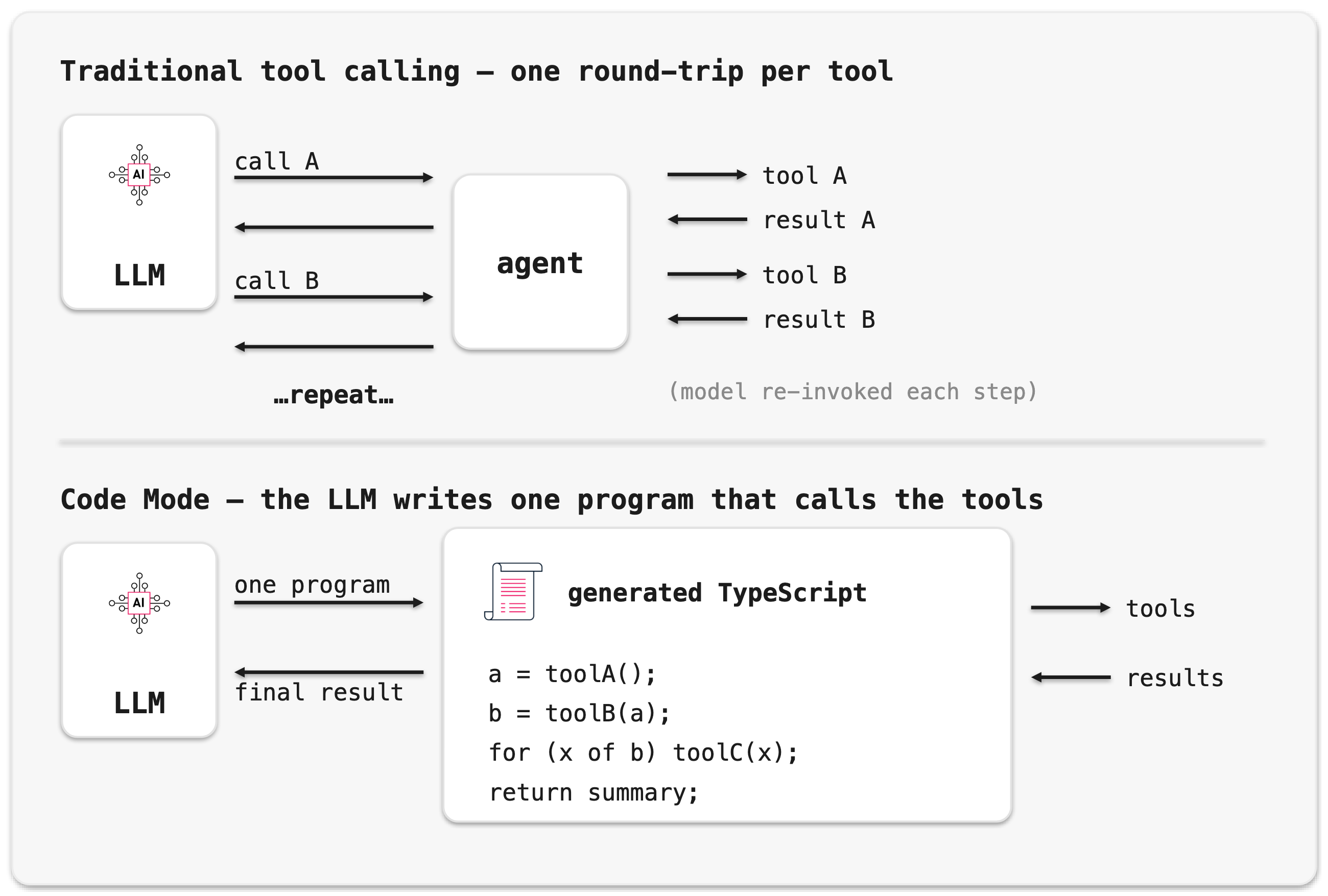
Figure 1 – Tool calling vs. Code Mode
That code has to run somewhere, and that “somewhere” is workerd, the runtime behind Cloudflare Workers.
2. The workerd origin story
To understand workerd, start with the product it was built for: Cloudflare Workers. Workers is Cloudflare’s serverless platform: you upload a piece of code and Cloudflare runs it at the edge, in data centers close to the user, on demand for every request. There’s no server to manage and, ideally, no cold machine to wait for.
That model creates a hard isolation problem. Cloudflare runs code from a huge number of different customers, and to keep latency and cost down it packs many of them onto the same machines, and, as we’ll see, into the same process. The classic answer (a container or VM per tenant) is far too heavy for this: each one adds tens to hundreds of milliseconds of cold start and a real memory footprint, which is exactly what an edge platform serving oceans of short requests cannot afford.
Cloudflare’s answer is to isolate at the language-runtime level rather than the OS level, using V8 isolates, the same primitive Chrome uses to separate browser tabs. An isolate is a lightweight, independent JavaScript context. Many can live inside a single process, each starts in single-digit milliseconds, and the isolate is the security boundary between tenants.
The trade-off is that this boundary is a software boundary inside one shared address space, not a hardware or kernel one. Untrusted code runs in-process, and the whole model rests on the isolate holding.
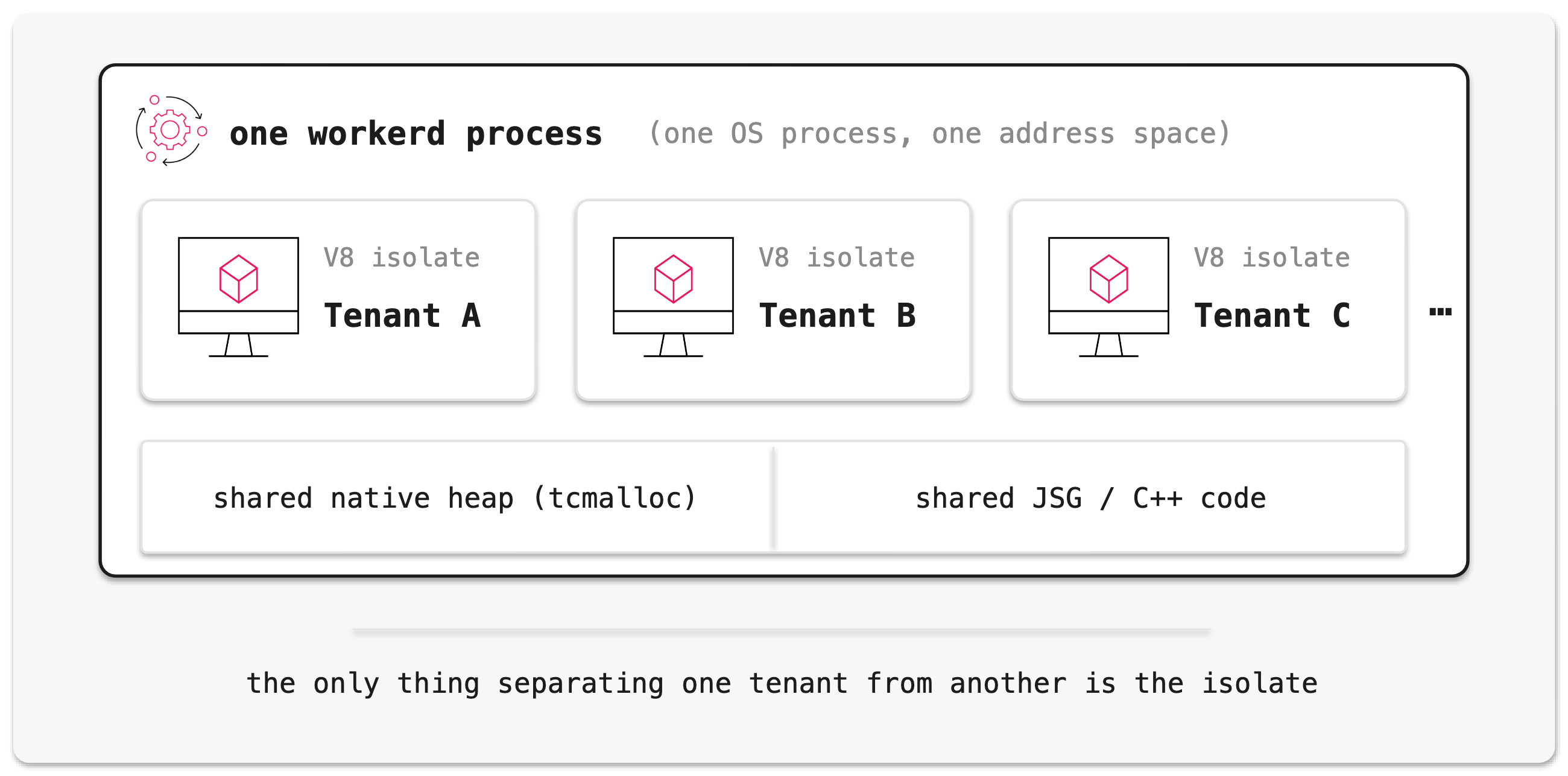
Figure 2 – Many tenants, one process
workerd is the runtime that implements all of this. It was closed-source for years: Workers launched in 2017, but Cloudflare only released workerd as open source in September 2022.[5] It’s exactly what Code Mode runs the model’s generated code on.
3. Why workerd was the obvious sandbox for Code Mode
Code Mode has to run untrusted, model-written code, and it needs that code to reach the declared MCP tools and nothing else. workerd answers both at once.
Running untrusted tenant code in-process is its day job, and it lets Code Mode lock the rest down: no filesystem, no arbitrary network (fetch() and connect() simply throw) with the tools exposed only through bindings.[6] Cloudflare didn’t build a new sandbox for Code Mode. It reused the one it already trusts to isolate millions of Workers.
4. Why we targeted workerd
When you set out to break Code Mode, the obvious place to look is the seam between Code Mode and workerd. This is the integration layer: how tools become bindings, how the configuration is wired, how the two interact. Going after the runtime itself is the unusual move. It’s a bit like setting out to break an AI coding assistant and then going to audit Docker’s own source code, the container runtime itself, not the agent on top of it.
Five reasons made us decide to do it anyway:
- An in-process sandbox is a bold, inherently risky bet. Isolating untrusted code without an OS-level boundary means no VM, no container, just a V8 isolate inside a shared process. That puts the entire security model on a single software boundary. That kind of ambitious bet is exactly what’s worth stress-testing.
- workerd had almost no public scrutiny.[7] Despite sitting directly on that boundary, there was barely any prior public vulnerability research on workerd, in stark contrast to V8, which is picked apart continuously.
- The attack surface is huge. And it’s not just V8. workerd has its own implementation that exposes many Web/Node APIs, each written in C++ and reachable from untrusted JavaScript.
- The blast radius reaches Cloudflare Workers. workerd isn’t only Code Mode’s runtime. It’s the engine behind Cloudflare Workers, one of the most widely deployed serverless platforms on the internet. A bug here would never have stayed contained to an experimental agent feature.
- AI security has a low-level side too. Beyond the high-level frameworks, the internal, low-level layers that agents rely on to interact with the world deserve research as well.
5. The cage, memory protection keys, and Node
V8 is one of the most heavily attacked pieces of software around, with a long history of memory bugs, so Cloudflare assumes it can break and layers defenses so a compromise of one isolate doesn’t reach the host or other tenants.
Defenses
1. The V8 sandbox (“the cage”). The cage confines JS-reachable objects so a corrupted one can’t forge pointers outside it. Assume arbitrary read/write inside the cage, and stop it reaching memory outside.
2. Memory protection keys. As a further layer against V8 vulne
Key Takeaways
- Five memory-corruption bugs found in workerd's native C++ glue layer.
- Two critical vulnerabilities enable sandbox escapes and cross-tenant attacks.
- Cloudflare fixed managed Workers; self-hosted deployments must update immediately.