Thousands of Hacked WordPress Sites, One Operation: Unmasking StopAndProtect
August 18, 2026 · Check Point Research · Severity: HIGH
Check Point Research has uncovered a large-scale operation called StopAndProtect that combines file encryption with data theft, abusing thousands of hacked WordPress websites as infrastructure. The infection chain begins with a ClickFix social-engineering technique that prompts victims to execute a PowerShell command, leading to multiple stages of downloaders and loaders. The operation does not rely on a single malware strain but rather a toolkit of criminal software including ransomware, SMB and USB worms, lock screen utilities, and credential stealers. Operational security failures by the developer exposed detailed infection logs from victims machines, screenshots from infected computers, and source code of tools used to mass-manage compromised websites, revealing thousands of affected IP addresses predominantly in the US, Russia, and India.
Research by: Jaromír Hořejší (@JaromirHorejsi)
Key points
- StopAndProtect is a newly identified operation that combines file encryption with data theft. The criminals abuse thousands of hacked WordPress websites as their infrastructure – using them to spread the malware, control infected machines, and store stolen documents, screenshots, and activity logs (records created by malware to track its actions, progress, or status during execution).
- Operational security (OPSEC) failures by the developer exposed lots of files, including detailed infection logs from victims’ machines, screenshots from infected computers, and source code of tools the criminals use to mass-manage compromised websites.
- Internal logs reveal thousands of IP addresses affected by this operation, underscoring that this is not a small, isolated incident but a large-scale campaign that targets victims across many regions and networks, where most IPs belong to the US, Russia, and India.
- The operation doesn’t rely on a single piece of malware, but on a whole toolkit of criminal software working together – some components encrypt files, others silently steal documents or lock the screen, and another acts as a live chat between the attackers and their victims.
Introduction
We first noticed a ransomware family called StopAndProtect in the middle of May 2026. Further analysis of the infrastructure reveals that the infection chain starts with a ClickFix social-engineering technique, which prompts victims to execute a PowerShell command. This leads to two stages of additional downloaders and loaders written in .NET, followed by several main functional components, such as ransomware, SMB/USB worm, LockScreen, VBS spreader, chat utility and credential stealer.
Although the name StopAndProtect was originally given to the ransomware component, we decided to call the whole operation StopAndProtect, as it does not deploy ransomware on all its victims. In many cases, the attackers silently exfiltrate lists of files and later specific files from the infected machines.
All these stages collect telemetry and generate and upload logs, giving malware operators a detailed view of the progress of the infection on the affected machines.
Malware operators use hacked WordPress sites as infrastructure to host malware stages, as C&C servers to pass commands, as well as the storage of logs exfiltrated from victims. Due to their carelessness and not following proper operational security measures, we discovered a PHP script exposing a directory listing, which led to the discovery of even more log files and open directories. Parsing those logs can provide us with an overview of the size and magnitude of the overall operation.
In one scenario, we suspect that the malware operator infected themselves and accidentally uploaded some of their desktop files to the collection server. This archive contains the source code of an automation tool for managing injected payloads at scale on compromised WordPress sites. It also contains a few text files listing close to 2,000 compromised WordPress domains, giving us a hint about the size of the operation.
There are many vulnerable WordPress websites simply because their owners do not keep them updated. This is true not only for WordPress itself but also for installed plugins.
Out of curiosity, we scanned one compromised WordPress website and found that it was running a WordPress version from 2021—almost five years old. The scan identified nearly 40 different vulnerabilities, including expired certificates, SQL injection flaws, open redirects, authentication bypasses, authenticated arbitrary file uploads, and more.
Infection chain
When visiting a compromised website, an unsuspecting victim sees a fake CAPTCHA ClickFix prompt. If the victim falls for the ClickFix prompt and infects themselves, there are multiple stages of infection, all using compromised WordPress sites to download additional stages, upload logs, or download instructions on which machines to encrypt and which files to steal.
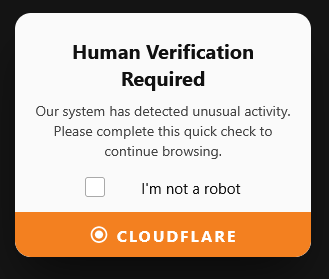
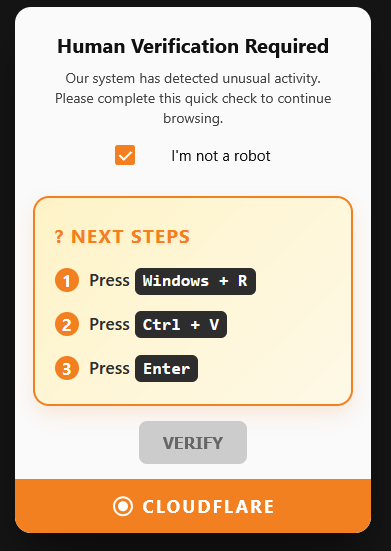
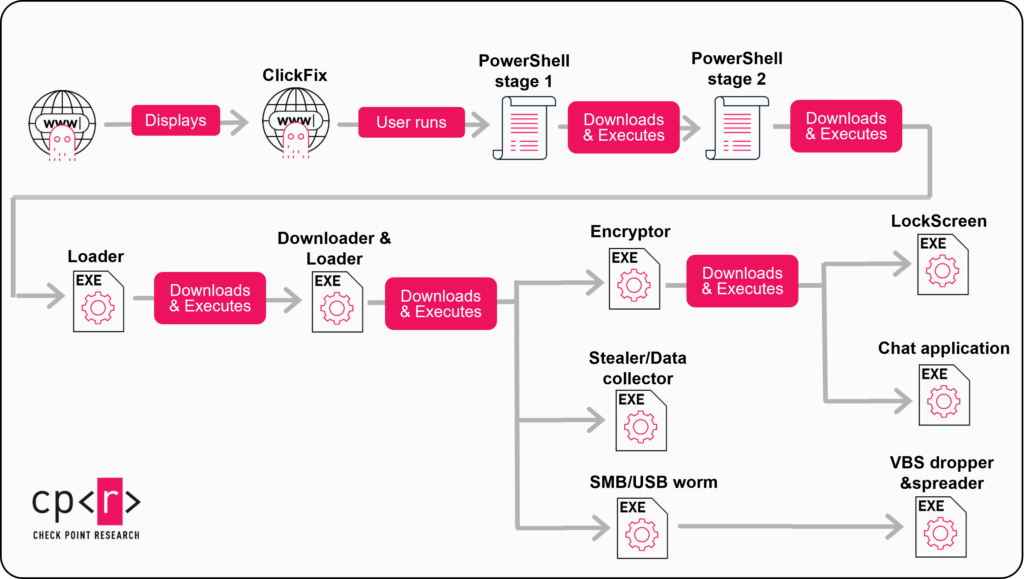
The infection chain follows the sequence and schematics shown below:
ClickFix → PowerShell script 1 → PowerShell script 2 → stage 1 (loader) → stage 2 (downloader & loader) → stage 3 ( components: encryptor, SMB/USB worm, lockscreen, credential stealer, VBS spreader, chat utility )
The first stage of the PowerShell script submits an execution log to the base C&C server and downloads and executes the second stage of PowerShell. The second PowerShell stage downloads the base64-encoded .NET stage 1. It decodes it and loads it into memory. It then enumerates types from the .NET assembly. For each type, it lists all of its methods, and if a method name is Execute and it is static and has no parameters, it then creates a new instance of that type and invokes the found method.
- .NET stage 1 is a simple downloader, which reports more statistics to base C&C servers and decodes and loads the stage 2.
- .NET stage 2 is a persistent downloader and loader that contains sandbox checks and even more logging.
- .NET stage 3 includes several components. Their analysis will be discussed in the
Malicious payloadsections.
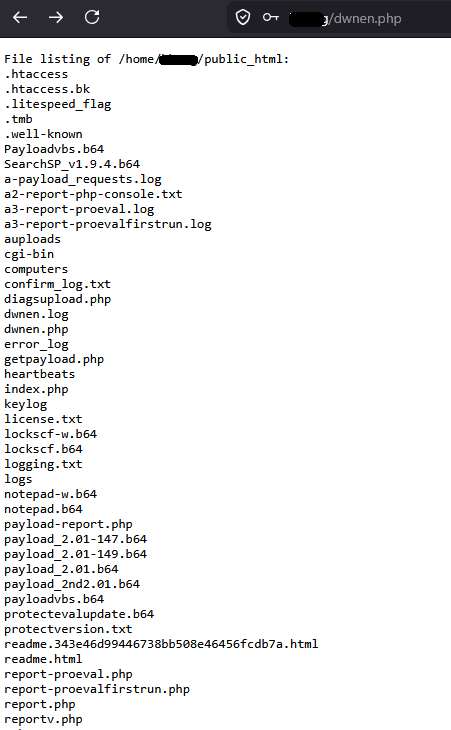
PHP scripts with file listings
While analyzing files belonging to stages 1, 2 and 3, we extracted compromised WordPress websites acting as base C&C servers. One of these stages downloaded the next component from a dwnen.php endpoint. When we queried the endpoint without any parameter, we were presented with the following file listing. We could download all files except for .php files, and we could even list some of the folders as they allowed directory listings. This helped us a lot with collecting interesting files and samples, because without file listings we would not know which files had been hosted on the exposed server.
PHP files used for file management
While listing files on known compromised websites, we noticed a few custom PHP scripts uploaded by the attackers. Some of these PHP files displayed password-protected forms for the custom file management utilities. These utilities are general file explorers, secure uploaders and secure downloaders.
Key Takeaways
- StopAndProtect is a large-scale operation combining file encryption with data theft through hacked WordPress sites.
- Thousands of hacked WordPress websites serve as infrastructure to spread malware and store stolen data.
- Operational security failures by the developer exposed internal logs revealing thousands of compromised IP addresses.