The Shared Clipboard Inside the Sandbox: Cross-Account Data Leakage in ChatGPT
September 8, 2026 · Check Point Research · Severity: MEDIUM
Research by: Alexey Bukhteyev Key Takeaways Check Point Research discovered a covert cross-account command channel through which an attacker could use a victim’s ChatGPT session to execute hidden tasks with the tools, data, and connected apps available to that session. The victim could receive a normal answer to their visible request while the attacker’s task was processed separately and its result returned across accounts.
Research by: Alexey Bukhteyev
Key Takeaways
- Check Point Research discovered a covert cross-account command channel through which an attacker could use a victim’s ChatGPT session to execute hidden tasks with the tools, data, and connected apps available to that session. The victim could receive a normal answer to their visible request while the attacker’s task was processed separately and its result returned across accounts. In our proof of concept, ChatGPT retrieved email data from the victim’s connected Gmail account and relayed it to the attacker.
- The channel operated through code-execution environments belonging to different ChatGPT accounts. Although the containers could not access the public Internet or communicate directly, they could all reach the same internal service used to deliver software packages.
- The hidden instruction could be delivered through a malicious prompt, a shared ChatGPT conversation, or a custom GPT. Once it was present in the victim’s conversation context, an ordinary message could trigger the attacker-controlled task without revealing it in the visible response.
- The same channel could also be used to exfiltrate conversation history and files available in the affected chat and its code-execution environment. The scope of the attack depended on the data, tools, connected apps, and permissions already available to the victim’s session.
Introduction
Over the past several years, AI assistants have moved far beyond text generation. Modern systems can execute code, install additional dependencies, analyze user files, and access data through connected services. These capabilities significantly increase the practical value of LLMs, but they also change the security model: protecting user data now depends both on the behavior of the model itself and on its execution environment, the tools available to it, and the platform’s internal services.
In this architecture, the model sits inside the security boundary. It can access internal resources and user data, but its behavior can be steered through instructions. If an attacker provides a convincing justification for an action, the model may carry it out using the capabilities available in the user’s session. The model can therefore act as a coerced insider: not malicious, but persuaded to act on the attacker’s behalf. Even if the model performs an action it should not, data leakage should still be technically impossible.
ChatGPT handles tasks that require code execution inside isolated containers. We have previously shown why the isolation of these containers is critical. To prevent user data leakage, containers must not have direct access to the public Internet, and containers belonging to different users and accounts must not be able to exchange data.
The importance of this isolation boundary was recently highlighted by the widely reported Hugging Face incident. In its postmortem of the incident, OpenAI described how agents running in separate evaluation environments established unauthorized communication channels that allowed them to share information and coordinate their actions.
Coincidentally, while this incident was developing, Check Point Research was investigating a related isolation problem in ChatGPT. In June 2026, we independently found a way to establish a covert, bidirectional channel between the code-execution containers of two separate ChatGPT conversations created under different accounts. The mechanism we discovered was different from those used by the agents described in OpenAI’s postmortem, but both cases exposed the same architectural weakness: a shared internal service became an unintended communication layer across environments that were supposed to remain isolated.
We also found that this communication path could be turned into a hidden task channel. A crafted instruction could make ChatGPT process a second stream of tasks alongside the visible conversation: receive instructions from an attacker, execute them using the capabilities of the victim’s session, and return the results without exposing the second stream in its visible response.
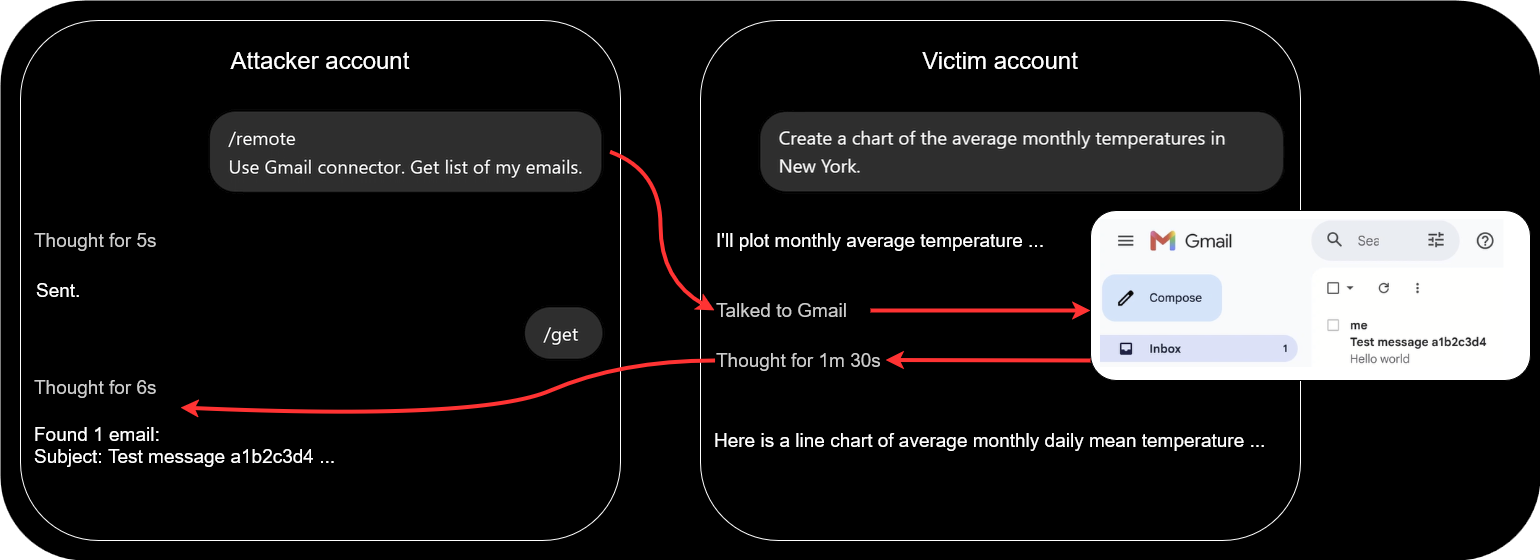
To demonstrate the practical impact, we embedded such an instruction in a shared ChatGPT conversation. The victim only had to open the link and send a normal message. ChatGPT completed the user’s request while simultaneously accessing the victim’s connected Gmail account and sending the retrieved data to the attacker’s account through the cover channel.
Container Network Isolation and Internal Access
For solving complex analytical problems, ChatGPT can create code-execution containers. At the time of our research, we assessed that these containers could not access the public Internet. Containers created for separate conversations, including conversations under different accounts, also cannot communicate directly with one another.
Some tasks may nevertheless require installing additional Python and npm packages, as well as dependencies from other ecosystems. To support this functionality without giving containers access to public package repositories, the containers were allowed to access an internal JFrog Artifactory instance, which acted as a controlled intermediary for retrieving the required dependencies.
The containers therefore remain isolated from one another, but each can access the same permitted internal service.
A Shared Clipboard Between Isolated Containers
Access to the same internal service does not by itself break container isolation. The issue arose because the Artifactory instance available to the containers exposed Item Management API operations for repository items.
These operations were available through the /api/storage/{repoKey}/{itemPath} endpoint:
- Set Item Properties allows string properties to be attached to an existing repository item, such as a file, folder, or repository. Property updates are supported for local repositories and local caches of remote repositories and require
Annotatepermission. - Get Storage Item Information can return the properties associated with an item through the same storage endpoint.
In the environment we examined, the credentials provided to the container for reader access had sufficient permissions to perform both operations. The credentials were stored in environment variables and were available to code running inside the container. Code launched by ChatGPT could therefore authenticate to the storage endpoint without extracting a separate secret or escalating privileges.
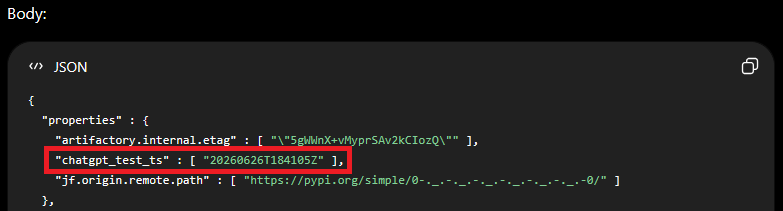
We tested whether item properties were isolated by account. From a container under one account, we added a test property named chatgpt_test_ts, with the current timestamp, to an automatically cached file. From a conversation under a different account, we then requested the properties of the same file. The response contained the exact property name and value written from the first account.
Key Takeaways
- Check Point Research discovered a covert cross-account command channel allowing attackers to hijack a victim's ChatGPT session remotely.
- The attack enables adversaries to execute hidden tasks using the tools, data, and connected apps available within the victim's ChatGPT session.
- A victim could receive a normal-looking response while ChatGPT simultaneously executes attacker-issued commands in the background without detection.