The Odyssey and trojans again: MovieReaper attacks users in multiple countries via compromised torrents
September 17, 2026 · Kaspersky (Securelist) · Severity: HIGH
Introduction Torrent trackers have long been abused for distributing malicious software, disguised as popular films, games, and other content. Our previous research has shown that cybercriminals repeatedly turn torrents as an initial infection vector, using trojanized cracks and installers to reach a large number of users. Installation guides for pirated software routinely instruct users to disable their antivirus, conditioning them to ignore potential threats they are inviting onto their computers. During our analysis of malware that leverages blockchain networks for its C2 infrastructure , we have discovered a previously unknown modular, multi-stage framework that we dubbed MovieReaper. This report details the new crimeware campaign that began with the mass infection of users via compromised torrent tracker file storage.

Introduction
Torrent trackers have long been abused for distributing malicious software, disguised as popular films, games, and other content. Our previous research has shown that cybercriminals repeatedly turn torrents as an initial infection vector, using trojanized cracks and installers to reach a large number of users. Installation guides for pirated software routinely instruct users to disable their antivirus, conditioning them to ignore potential threats they are inviting onto their computers.
During our analysis of malware that leverages blockchain networks for its C2 infrastructure, we have discovered a previously unknown modular, multi-stage framework that we dubbed MovieReaper. This report details the new crimeware campaign that began with the mass infection of users via compromised torrent tracker file storage. We have identified several hundred victims, including both individual users and organizations in a multitude of countries, such as Russia, Türkiye, Japan, Kenya, Uganda, and Colombia, as well as in several European countries like Spain, the Netherlands, Belgium, Germany. We analyze the techniques used to evade detection by security and sandbox solutions, examine the capabilities of the modular framework.
Kaspersky products detect this threat as HEUR:Trojan.Win64.Agent.gen.
Technical Details
Background
In mid‑August 2026, during our threat‑hunting efforts, we identified a large‑scale infection campaign involving previously unknown malware disguised as popular movies. The campaign affected both individuals and organizations across multiple countries. Our initial analysis revealed a common factor among the victims: all had used torrent trackers. This finding prompted us to investigate the campaign further and analyze its distribution mechanism, overall scope, and unknown malware implants.
Initial infection and spreading
Compromised torrent trackers are the primary vector used to distribute malware. During our investigation, we identified multiple user reports describing suspicious files being downloaded instead of the intended content.
For example, a user of a popular movie torrent tracker reported the following case on Reddit:
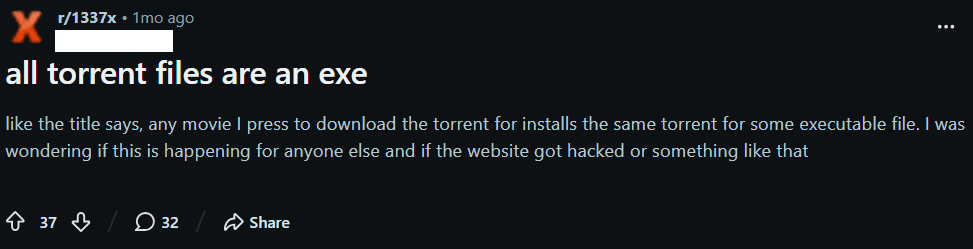
Further analysis of the attack revealed that the threat actors did not compromise the torrent trackers themselves. Instead, they compromised a widely used public repository of torrent files — itorrents[.]org. As a result, torrent trackers that relied on this repository began inadvertently distributing malicious torrent files to their users. This approach is particularly powerful because the threat actors can reach users of multiple tracчkers without compromising each platform individually.
As of the publication date of this report, the archive remains compromised. When a user attempts to download a torrent using a magnet link, the legitimate torrent archive instead returns a different torrent file. This malicious torrent leads to the download of the malware loader. It is used to deploy a framework that we dubbed MovieReaper.
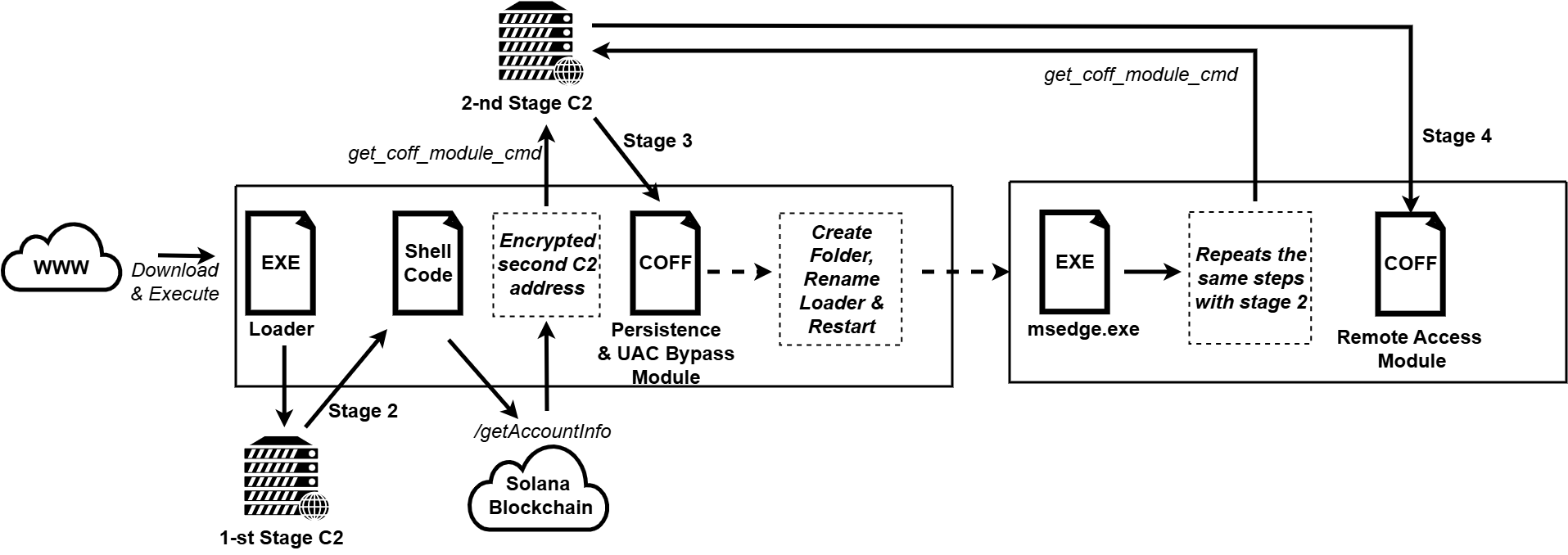
The loader initiates the infection chain, which is illustrated in the diagram below. Each stage of the infection chain is described in detail in the following sections.
Malware implants
The infection chain consists of several steps, where only the initial one is dropped on the disk before its execution to avoid detection. The malware itself is not heavily obfuscated, apart from the fact that strings are encrypted with a custom stream cipher. Most of the countermeasures were aimed at avoiding detection by AV sandboxes.
Step 1: Loader
The most popular initial executable was distributed through torrent trackers under many different names (for example, the odyssey (2026) [1080p] [webrip] [5.1].exe), but the file hash (MD5: A0B13781EDD7CFDAB13D79AFFF3C83C1) was identical across all downloads. We have seen multiple different loaders, where the executable file disguises itself with a long filename and an icon of some well-known application. Most of the filenames are rather large, presumably, to hide the “.exe” extension at the end.
After the user manually starts the application, it establishes a global mutex to ensure that only one loader is executed at a time. We have seen several variations of a mutex in our samples, which contain a randomly generated string (in example Global\fnulSktzSqvVLXHU). Then this executable performs the series of operations in order to avoid detection by the AV sandbox solutions.
While performing those operations, the malware avoids making LoadLibrary and GetProcAddress calls in order to acquire addresses of required functions. Instead, it searches for loaded libraries by traversing the double-linked list taken from the Ldr field of PEB and then performs manual parsing of loaded DLL to calculate the address of function.
After all the initial checks have passed, this binary prepares to perform network connection to a C2 web-server to download the shellcode, map it into the RWX memory and execute. While doing it, loader decodes https://deadhub[.]org domain name and if connection to it has failed, then it uses the IP address http://193.23.118[.]155 as a fallback and connects to it using plain HTTP. Malware chooses a random group of strings and uses them as a path in the HTTP request to download parts of a shellcode.
Example URLs:
/cloud/v192.4/ui/sync-status-icons.png
/cloud/v192.4/onboarding/welcome-bg.jpg
/cloud/v192.4/ui/file-preview-placeholder.png
/cloud/v192.4/shared/link-banner.jpg
While mapping the address space and executing the shellcode, the loader registers a vectored exception handler and rewrites the handler address in memory in order to perform a debug break, which will not crash the program, but instead redirect control-flow into the function that actually makes raw NtProtectVirtualMemory syscall (via previously located “0x0F 0x05” syscall instruction inside ntdll). Then it calls an undocumented ntdll function EtwpCreateEtwThread, which is a popular alternative to a CreateThread to perform code execution and executes the shellcode.
Step 2: Shellcode
The second stage of this malware performs an HTTPS request to the Solana blockchain at the /getAccountInfo endpoint for the 6pnDGAiHgyPdmckM5Qt1YbanGzrX43WLEU159nRaNLDm account. The data field of the response contains the base64‑encoded address of a second C2, which is encrypted with a static XOR key located within the shellcode itself. To store data in this account, attackers used a simple Solana program (address: CSiY8bQLBYPdfPWkwipBzH6sijTVQVVsA279JQdvwHtL).
By using Solana blockchain network as a distribution layer of endpoints for a next stage attackers may increase stability of their campaign and resist takedown efforts of defenders.
Key Takeaways
- MovieReaper attacks target users in multiple regions by posing as movie download sites to deliver trojans that steal credentials and cryptocurrency wallets.
- The campaign exploits user demand for free movie downloads to distribute malware that performs credential theft and cryptocurrency wallet draining on compromised systems.
- Users should avoid downloading movies from unofficial sources and maintain updated endpoint protection to defend against trojanized media file attacks.