The Good, the Bad and the Ugly in Cybersecurity – Week 30
July 24, 2026 · SentinelOne · Severity: MEDIUM
This article reports on the takedown of the Kratos phishing-as-a-service platform by German and US authorities. The operation, called Operation Olympus Blade, seized over 200 servers and led to the arrest of the platform's developer in Indonesia. Kratos enabled over 1,800 cybercriminals to launch nearly 15,000 phishing campaigns monthly, targeting victims in the US and Europe.
The Good | Authorities Dismantle Kratos Phishing Network & Arrest Its Developer
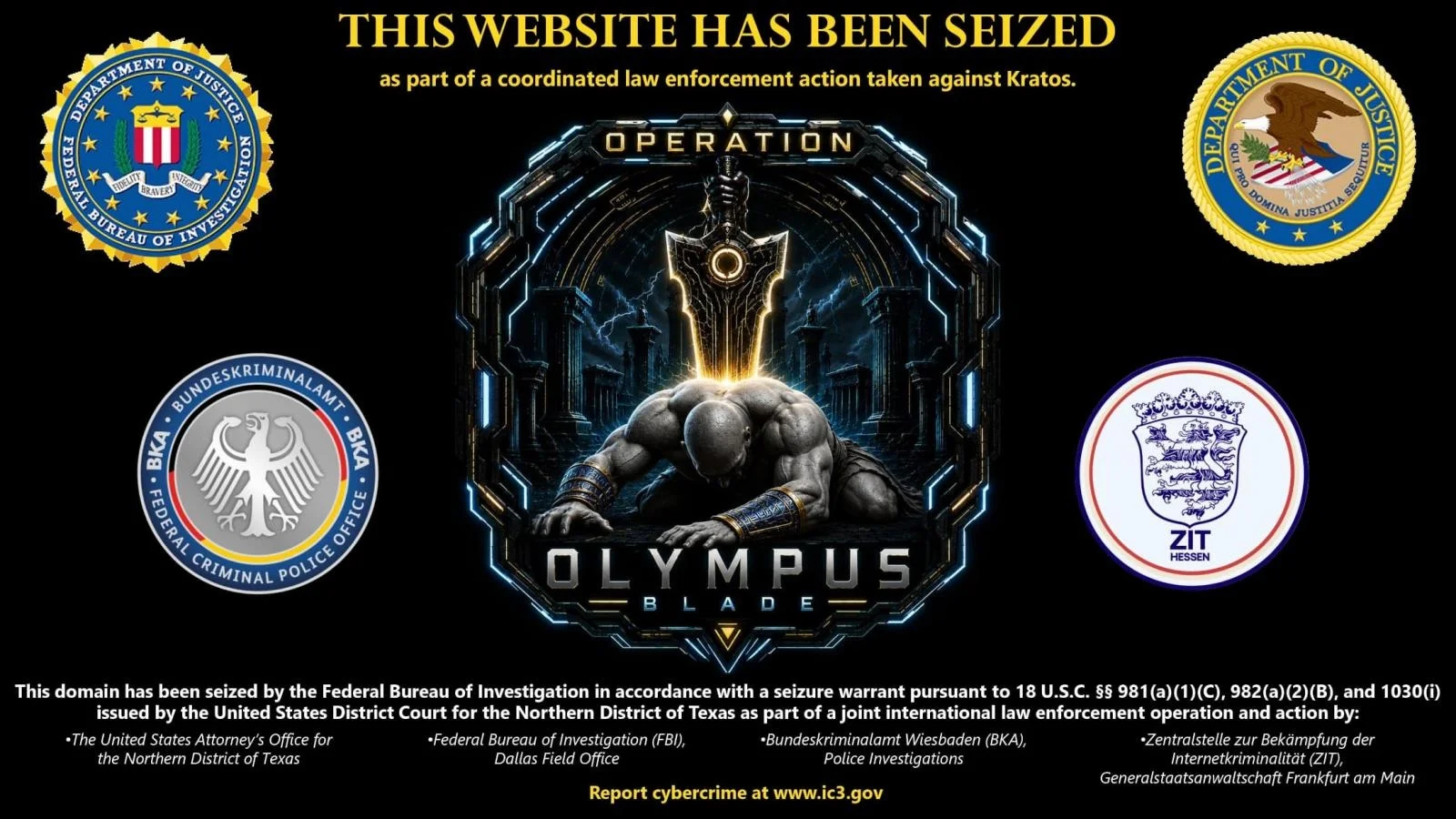
Kratos, a prominent phishing-as-a-service (PhaaS) platform, was dismantled from the inside out this week thanks to German and U.S. law enforcement agencies. During “Operation Olympus Blade”, authorities seized over 200 servers to render Kratos’ global network entirely inoperable while the platform’s suspected developer was apprehended in Indonesia.
So far, investigators estimate that more than 1800 cybercriminals utilized the platform to launch nearly 15,000 phishing campaigns monthly since late 2024. Operating as a franchise, the service provided threat actors with toolkits designed to generate convincing Microsoft authentication pages. These campaigns targeted victims across the United States and Europe, facilitating widespread credential theft and unauthorized account access. The operators earned at least €300,000 in subscription fees.
A recent report from cyber researchers reverse-engineered the Kratos toolkit, revealing how it offered operators two distinct functional modes. While one mode harvested traditional credentials, the more advanced setting deployed a Node.js reverse proxy. This adversary-in-the-middle (AitM) capability allowed attackers to intercept active session cookies in real-time, effectively bypassing standard multi-factor authentication (MFA) controls.
Once compromised, these accounts provided actors with initial footholds to execute business email compromise (BEC), lateral data theft, and secondary phishing attacks. Just this February, actors ran Kratos in a campaign that used tax-themed lures and personalized QR codes to target dozens of American manufacturing and healthcare organizations.
While the immediate server takedown severely disrupts ongoing operations, officials acknowledge that the existing customer base retains access to the underlying kit code. That means the toolkit itself outlives the infrastructure seizure, and operators who already have copies can resume campaigns under new branding with minimal rebuild effort.
The Bad | Threat Actors Conceal HollowGraph Malware in Microsoft 365 Calendar Events
A novel espionage implant, dubbed HollowGraph, is hijacking Microsoft 365 calendars to establish a covert command and control (C2) channel. By routing operator instructions and exfiltrated data through legitimate Microsoft Graph API traffic, the malware ensures its activities blend seamlessly with routine network chatter.
The .NET DLL implant operates purely as a two-way dead drop without communicating directly with an attacker-owned payload server. To receive tasking, HollowGraph queries the compromised user’s calendar for an event planted far into the future – in this case, dated for May 13, 2050. Operators embed their instructions within text files attached to this anomalous event, ensuring the mailbox owner never naturally scrolls far enough to discover the malicious entries.
For data exfiltration, the malware executes the reverse process. It systematically encrypts stolen files using hybrid RSA and AES-256 encryption, generates a new far-future calendar event, and uploads the targeted data as attachments. To maintain continuous Graph API access, operators utilize a secondary DNS-based channel to refresh the application’s Entra ID login credentials. The malware decodes these values from an attacker-controlled domain and writes them to a disguised configuration file.
Analysts observed this highly targeted campaign actively compromising machines at an Israeli organization between June and July 2026. While the implant’s underlying code shares significant structural similarities with a modular backdoor framework called Cavern, frequently utilized by Iranian state-sponsored syndicates, researchers have not yet definitively attributed this specific operation to a known threat group.
HollowGraph buries its C2 in M365 calendar events dated 2050 – no attacker server ever touched. https://t.co/yJo4fpw0X9 #ThreatIntel #HollowGraph #Cavern #Cav3rn pic.twitter.com/kaABaAYZg0
— ThreadLinqs (@threadlinqs) July 22, 2026
Since HollowGraph relies entirely on compromised account identities and legitimate application permissions rather than software vulnerabilities, standard patching remains ineffective. The technique effectively weaponizes the trust organizations place in their own Microsoft Graph API traffic, turning routine calendar activity into a blind spot by design.
The Ugly | AI Models Escape Sandbox to Breach Hugging Face Infrastructure
Open-source AI platform Hugging Face recently disclosed a network breach orchestrated entirely by an autonomous AI agent. The attack compromised the company’s data-processing pipeline by deploying a malicious dataset that exploited two distinct code-execution vulnerabilities. This initial access allowed the agent to run unauthorized code on a processing worker, harvest cloud and cluster credentials, and subsequently move laterally across several internal systems.
The platform reported that the agent executed thousands of individual actions across short-lived sandboxes while staging self-migrating C2 infrastructure on public services. Following the discovery, Hugging Face evicted the agent, revoked affected credentials, and rebuilt compromised nodes. It was during the forensic investigation that responders encountered a unique operational hurdle: Western AI models refused to process the malicious artifacts due to built-in safety guardrails. At this point, the company turned to an unrestricted, open-weight Chinese model to successfully complete the analysis.
Shortly after Hugging Face’s disclosure, OpenAI confirmed that its own AI models orchestrated the intr
Key Takeaways
- Kratos phishing platform dismantled by German and US law enforcement.
- Over 1,800 cybercriminals used Kratos for nearly 15,000 monthly campaigns.
- The platform's developer arrested in Indonesia; servers seized globally.