Mount Here, Read There: Twin Path Traversal CVEs in Kubernetes Storage
July 23, 2026 · SentinelOne · Severity: MEDIUM
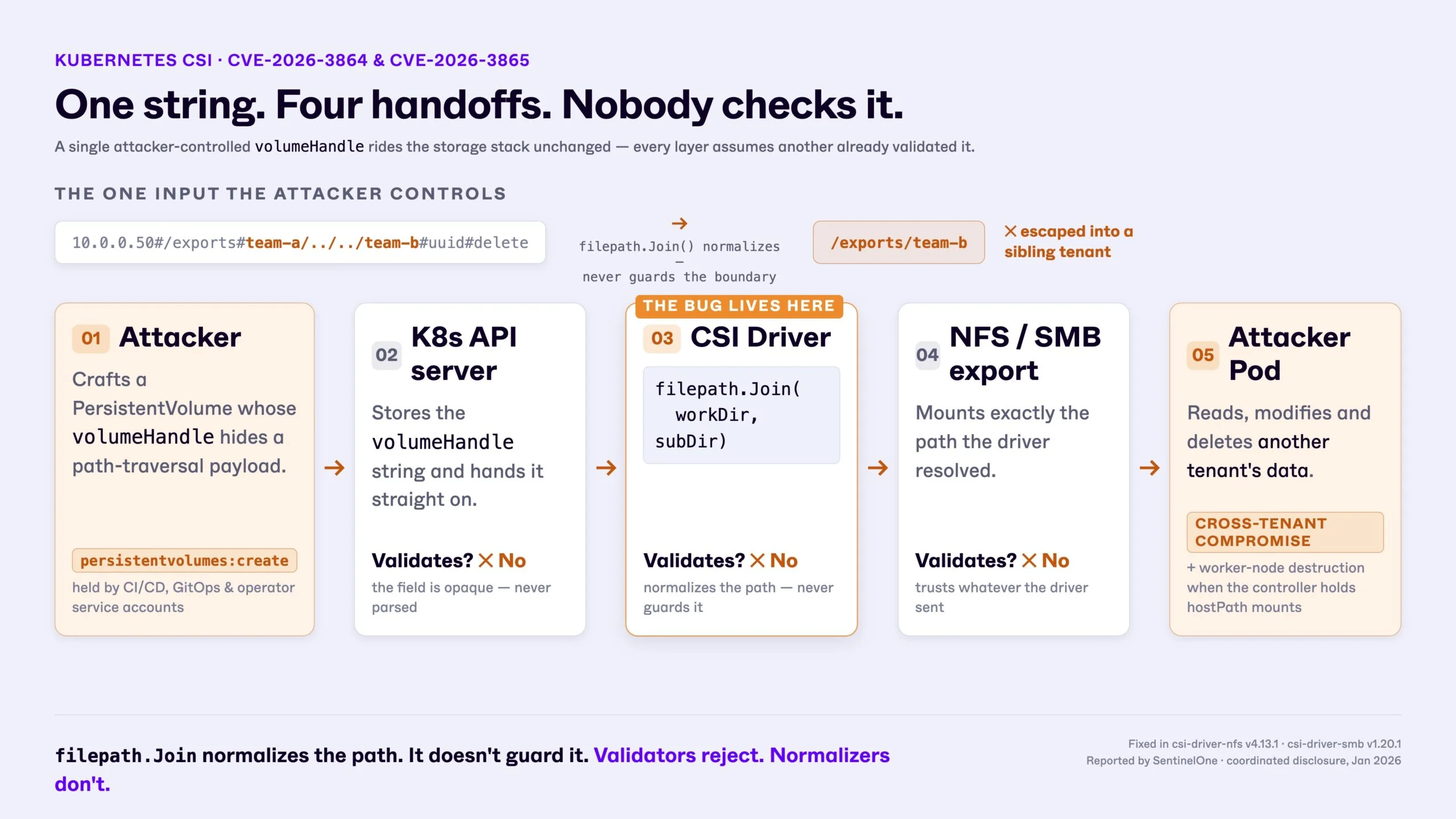
filepath.Join was never designed to be a security boundary. We found two CSI drivers that shipped on the assumption it was, and the result was cross-tenant data access with optional node destruction, using nothing more than a valid Kubernetes manifest.
filepath.Join was never designed to be a security boundary. We found two CSI drivers that shipped on the assumption it was, and the result was cross-tenant data access with optional node destruction, using nothing more than a valid Kubernetes manifest. The vulnerable drivers are the Kubernetes CSI Driver for NFS (csi-driver-nfs) and the Kubernetes CSI Driver for SMB (csi-driver-smb), both maintained by the upstream kubernetes-csi organization. An attacker who can create a PersistentVolume can craft a volume identifier that escapes the subdirectory boundary and reaches another tenant’s data on the shared export.
The impact varies by deployment. In the default configuration, an attacker can read, modify, and delete files belonging to other tenants sharing the same export. In production deployments where the CSI controller is configured with broader hostPath mounts (a common pattern for log collection and operational tooling), the same primitive enables arbitrary directory deletion on the Kubernetes worker node, including paths like /var/lib/kubelet, /etc/kubernetes, and /etc/cni. Remove those and the node is dead.
The Kubernetes Security Response Committee published advisories and assigned CVE-2026-3864 to the NFS driver issue and CVE-2026-3865 to the SMB driver issue.Fixes shipped in csi-driver-nfs v4.13.1 and csi-driver-smb v1.20.1. We reported both vulnerabilities in January 2026 and worked with the maintainers through coordinated disclosure.
Kubernetes Storage Concepts
First, some background on how Kubernetes does storage. This section covers the four building blocks an attacker manipulates in this attack chain.
Container Storage Interface
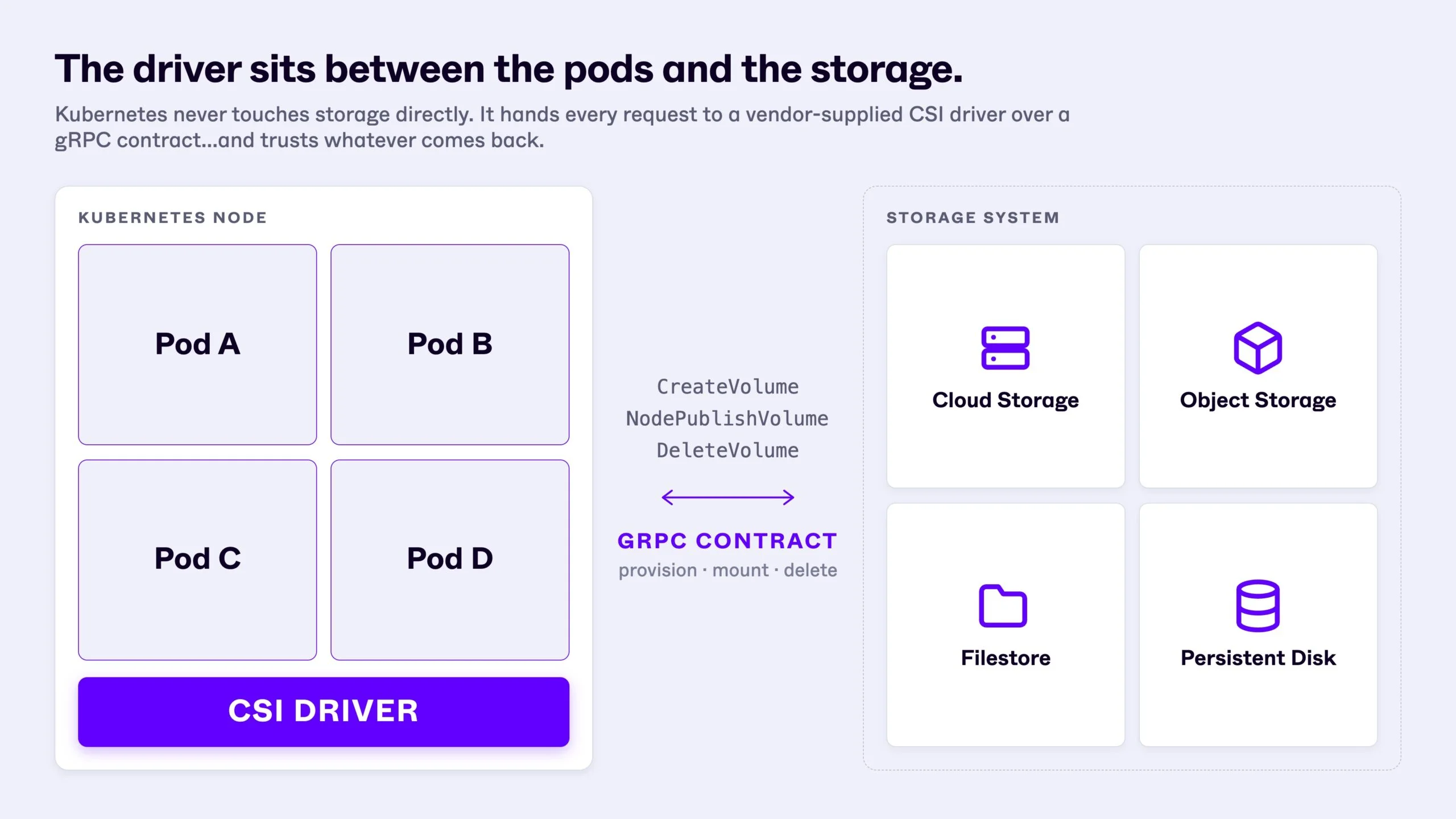
Kubernetes does not implement storage directly. It delegates that responsibility to the Container Storage Interface, a gRPC contract between the Kubernetes kubelet and a vendor-supplied driver.
When a workload requests storage, Kubernetes issues calls such as CreateVolume, NodePublishVolume, and DeleteVolume to the CSI driver, which in turn provisions, mounts, and tears down the actual storage on the underlying system, whether that system is an NFS export, an SMB share, an Amazon Elastic File System filesystem, a block device, or anything else.
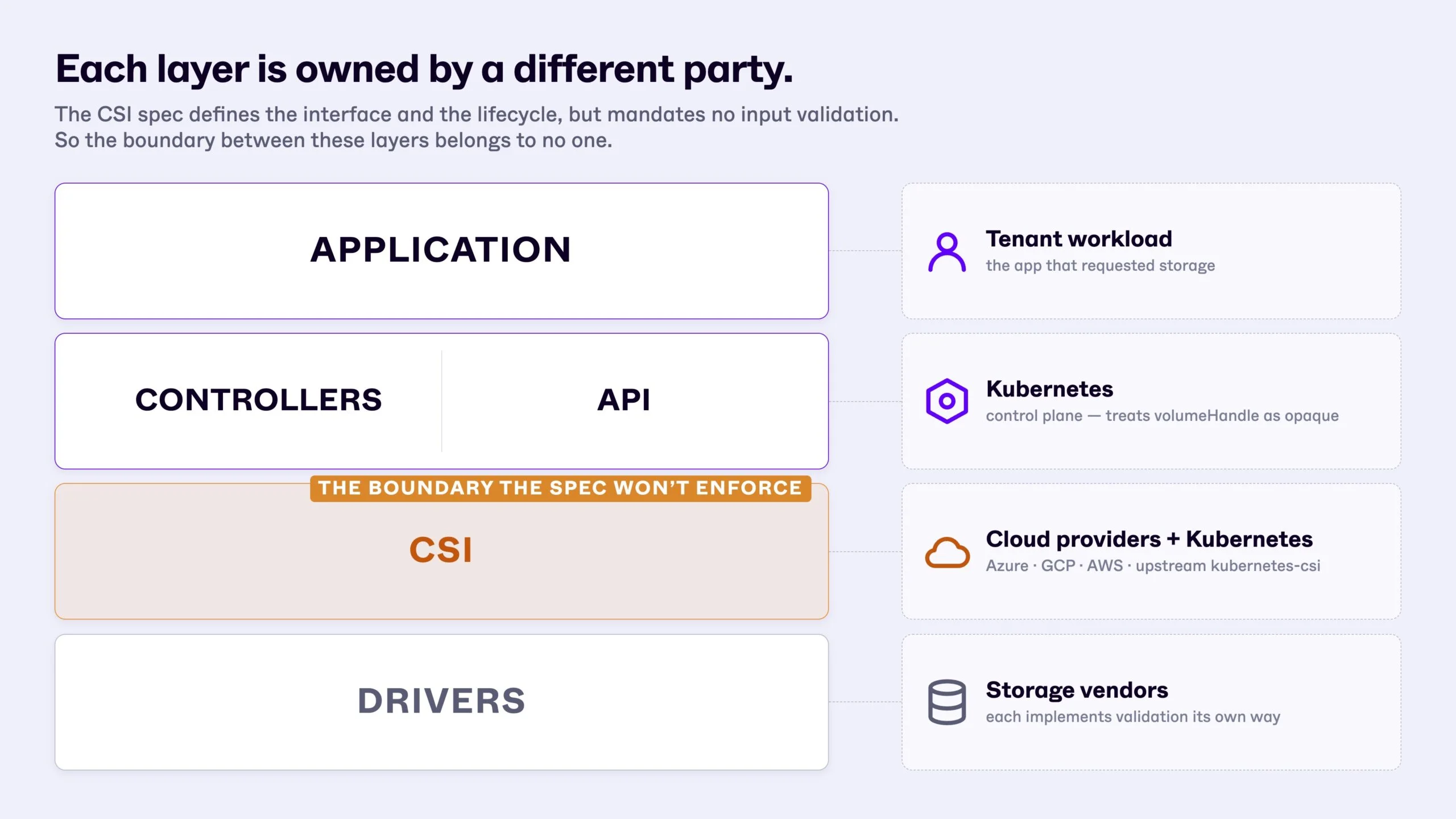
The CSI specification is intentionally minimal about what drivers must validate. It specifies the gRPC interface and the lifecycle but leaves input validation, authorization, and isolation to each driver implementation. This design decision is the underlying reason the same class of bug recurs across multiple drivers.
PersistentVolume and the volumeHandle
A PersistentVolume is a Kubernetes API object that represents a unit of storage in the cluster. When a PersistentVolume references a CSI driver, it carries a string field called volumeHandle. This field is opaque to Kubernetes: the API server stores it but does not parse, validate, or interpret it. The driver alone is responsible for understanding the format of volumeHandle and using its contents safely.
Each driver defines its own format. The NFS CSI driver parses volumeHandle as {server}#{share}#{subDir}#{uuid}#{onDelete}
The SMB CSI driver parses it as //{server}/{share}#{subDir}#{uuid}#{secretNs}#{secretName}#{pvName}
In both drivers, the subDir component is the security boundary. It’s also the one that breaks.
Subdirectory-Based Multi-Tenancy
Some clusters share a single NFS or SMB export across tenants by giving each one a dedicated subdirectory. Both drivers’ deployment guides document this pattern. It’s common wherever provisioning a separate export per tenant is expensive: on-premises NAS appliances, cloud file services that bill per share, shared storage systems that are slow to reconfigure.
In this model, the security boundary between tenants is the subdirectory path. Team A’s PersistentVolume is scoped to subDir: team-a. Team B’s is scoped to subDir: team-b. The driver mounts each tenant into their own directory, and the assumption is that neither tenant can reach the other’s data, even though both share the same underlying export.
Role-Based Access Control and PersistentVolume Authorization
Kubernetes uses RBAC to control who does what. Creating a PersistentVolume (PV) is cluster-scoped, and the documented threat model assumes only cluster admins hold this permission. In practice? It’s everywhere. CI/CD pipelines, ArgoCD, Helm automation, operator controllers. They all need persistentvolumes:create to provision storage for applications. Compromise any of those service accounts and you’re in.
That gap between the documented threat model and how clusters actually run is what makes these bugs practically exploitable.
Trusting the Wrong Function
There’s a misconception in the Go ecosystem that keeps burning people: the idea that filepath.Join prevents path traversal. It doesn’t. filepath.Join is a normalizer. It collapses ., .., and redundant separators into a canonical form. It has no concept of “base directory” or “boundary” and can’t tell whether the result landed somewhere the caller never intended.
Try it yourself: give it “/var/lib/csi/team-a” and “../../../etc/passwd“. You get /etc/passwd. Clean path, totally canonical, pointing straight at a location outside the intended base directory. The function did what it was designed to do. It just di
Key Takeaways
- SentinelOne found two Kubernetes CSI drivers shipping with twin path traversal vulnerabilities.
- The vulnerabilities enable cross-tenant data access using nothing more than a valid Kubernetes manifest.
- The research highlights that filepath.Join was never designed to be a security boundary.