IR Trends Q2 2026: Phishing and weaponized remote management tools drive attack chains
July 28, 2026 · Talos Intelligence · Severity: HIGH
Phishing was the leading initial attack vector in Q2 2026, accounting for over half of Cisco Talos IR engagements—up from a third last quarter. Attackers used QR code-embedded PDFs hosted on trusted cloud platforms to bypass email gateways, while authentication abuse surged to 65% of cases, with adversaries exploiting MFA weaknesses via AitM proxies, session-token theft, and MFA fatigue. Ransomware incidents remained steady at 20%, with new variants like Sinobi alongside known strains like Nitrogen and Warlock. Attackers increasingly abused legitimate RMM tools like MeshAgent and Zoho Assist for stealthy access, highlighting the need for behavior-based monitoring. A persistent QR phishing campaign targeted Australian organizations, leveraging compromised Microsoft 365 accounts to harvest credentials and spread via internal contacts. The threat actor, UAT-11764, used auto-generated PDFs with QR codes leading to fake M365 login pages, then created inbox rules, hosted malicious files on SharePoint, and sent further phishing emails. Meanwhile, the ARToken PhaaS platform provided attackers with tools for M365 compromise, including device code phishing, PRT persistence, and SharePoint exfiltration, bypassing MFA via OAuth flows. Defenders should block QR-laden PDFs, enforce phishing-resistant MFA, and monitor for suspicious activity like anomalous SharePoint usage or inbox rule changes.
Phishing was the primary means of gaining initial access this quarter, appearing in over half of all Cisco Talos Incident Response (Talos IR) engagements – an increase from approximately a third of engagements last quarter. Attackers continued to innovate their delivery methods to evade defenses, deploying QR code-embedded PDFs to bypass traditional email gateways and hosting links on trusted cloud platforms. We also saw a spike in authentication abuse this quarter — observed in 65 percent of engagements compared to 35 percent last quarter — with attackers frequently bypassing or defeating multi-factor authentication (MFA) using adversary-in-the-middle (AitM) proxies, session-token theft, MFA fatigue attacks, and self-enrolled devices, amongst other methods.
Ransomware incidents made up over 20 percent of engagements this quarter, similar to just under 20 percent last quarter. Talos IR responded to Sinobi ransomware for the first time, as well as previously seen variants Nitrogen and Warlock. We observed ransomware operators leveraging legitimate remote monitoring and management (RMM) tools, such as trojanized MeshAgent binary and Zoho Assist, for stealthy access, requiring defenders to prioritize behavior-based monitoring and strict control over administrative binaries.
In the latest Talos Threat Perspective episode, we explore these trends, and highlight where defenders have the best opportunities to detect attackers:
QR phishing campaign leverages trusted infrastructure to target Australian organizations
Starting in April, we observed a persistent QR code phishing campaign targeting primarily Australian organizations that leverages compromised Microsoft 365 accounts to harvest credentials and propagate the attack via internal contact lists. The campaign, which remained ongoing as of late June 2026, employs auto-generated, victim-tailored PDF documents containing QR codes that direct to adversary-controlled M365 credential harvesting pages. If credentials are successfully captured, the adversary attempts access to the victim’s Microsoft account and conducts various post-compromise actions including creating email inbox rules for defense evasion, leveraging SharePoint to host malicious documents, and sending additional internal and external phishing emails to continue the compromise chain.
We assess with high confidence that the threat actor, who we have dubbed UAT-11764, will almost certainly continue leveraging this QR code phishing operation, using each newly compromised mailbox's contact lists to expand its reach and sustain the campaign's momentum. By weaponizing existing, trusted infrastructure like SharePoint and M365, UAT-11764 can bypass many standard email security gateways. As such, network defenders should implement policies that block or flag emails containing QR codes within PDF attachments, enforce phishing-resistant MFA on M365 accounts, and monitor for suspicious inbox rule creation and anomalous SharePoint file staging as indicators of post-compromise activity.
ARToken platform provides toolkit for Microsoft 365 account compromise
Talos uncovered a phishing-as-a-service (PhaaS) operator platform, ARToken, in an engagement this quarter that is closely linked to the EvilTokens platform. According to our analysis, the ARToken panel exposes 80+ API endpoints for device code phishing, primary refresh token (PRT) persistence, email access, business email compromise (BEC) operations, and SharePoint exfiltration — all accessible to operators through a React-based dashboard. Our investigation into the platform found phishing lures that impersonate trusted vendors and abuse legitimate Microsoft services, allowing attackers to bypass MFA through the OAuth device authorization flow rather than stealing passwords.
ARToken extends beyond a typical phishing kit by providing affiliates with a comprehensive post-compromise toolkit. We observed capabilities including automated token management, persistent access through PRTs, OneDrive and SharePoint administration, geo-dynamic templates, inbox rule manipulation, cross-account keyword monitoring, and collaborative token sharing. We also identified advanced anti-analysis techniques, including layered evasion mechanisms and encrypted client-side payloads, highlighting the increasing sophistication of modern PhaaS platforms and reinforcing the need for organizations to monitor device code authentication, enforce Conditional Access policies, and strengthen defenses against token-based attacks.
Ransomware trends
Ransomware and pre-ransomware incidents made up over 20 percent of engagements this quarter, relatively similar to just under 20 percent last quarter. As previously mentioned, Talos IR responded to Sinobi ransomware for the first time, as well as previously seen variants Nitrogen and Warlock. We observed operators from these groups leveraging tools not previously identified in public reporting, including a trojanized MeshAgent binary and Zoho Assist for remote access.
Sinobi ransomware operators weaponize MeshAgent for covert backdoor access
We responded to a Sinobi ransomware engagement for the first time in April; while this ransomware-as-a-service (RaaS) operation emerged nearly a year ago, there has been minimal public reporting on the actors’ operations.
Notably, we observed the threat actors use a trojanized MeshAgent binary as their primary C2 mechanism during this engagement, a tactic that has not been previously associated with the group in public reporting. MeshAgent is the open-source agent component of the MeshCentral remote management platform. Here, the actor weaponized it into a covert durable backdoor installed as a SYSTEM-level auto-start service, communicating over encrypted WebSocket (WSS) to an attacker-controlled server. This approach allowed the actor to blend malicious traffic with legitimate remote management activity and maintain undetected access for approximately three days before ransomware deployment.
Following C2 establishment, the actor moved laterally through the network using RDP and WinRM, leveraging a service account with a weak, easily cracked password obtained from the domain credential store, ntds.dit. The actor ultimately deployed the ransomware across the entire domain using a malicious Group Policy Object (GPO) logon script. The incident resulted in the encryption of systems with the .SINOBI file extension, alongside observed data exfiltration staging activity conducted via rclone.exe.
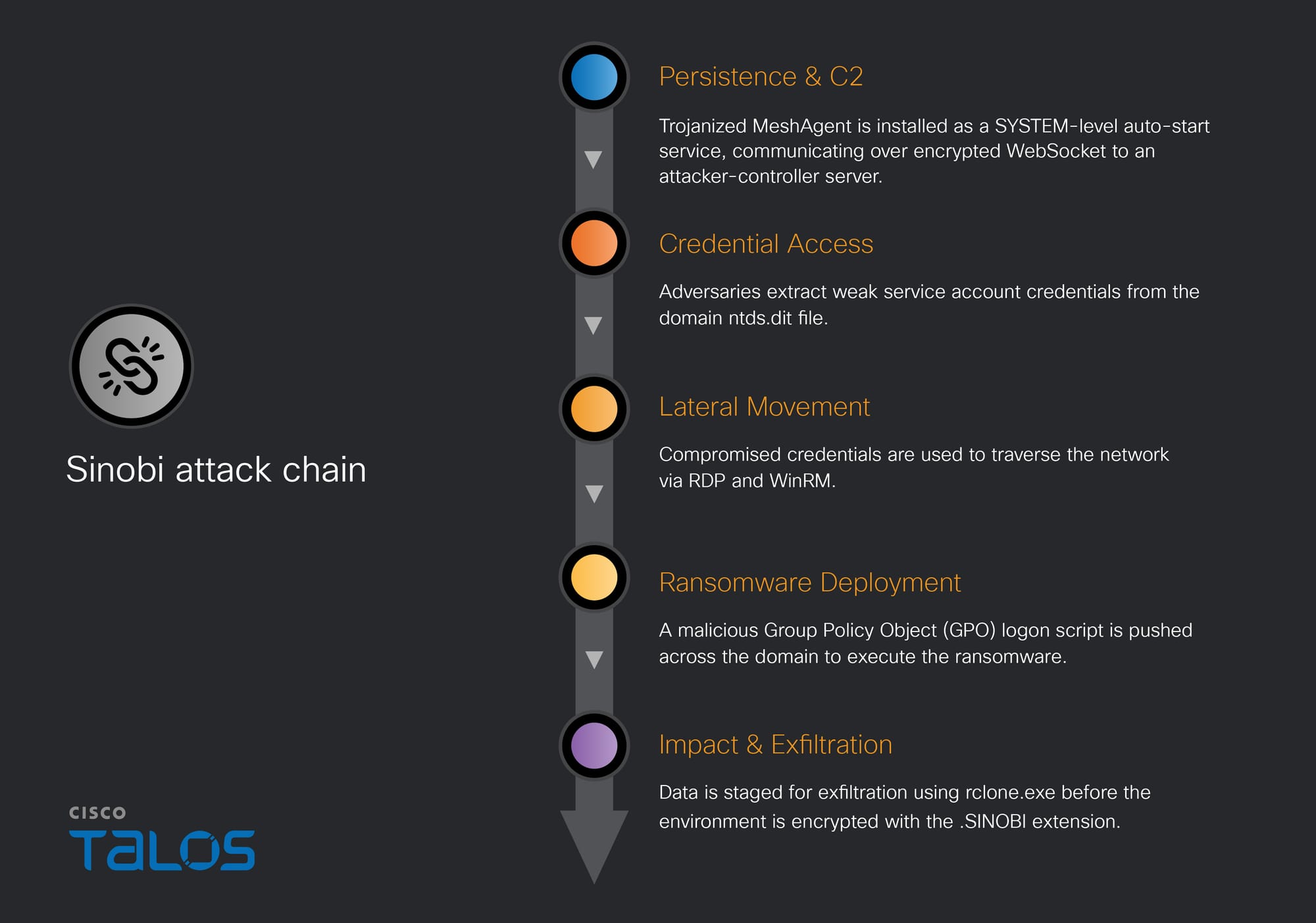
Looking forward, Sinobi operators will likely continue weaponizing legitimate tools like MeshAgent because these binaries blend into standard administrative traffic and bypass many traditional signature-based alerts. The use of GPO-based deployment scripts suggests an understanding of enterprise architecture, and operators will likely continue to exploit centralized management features to ensure rapid, domain-wide encryption. Defenders should prioritize monitoring of administrative tools and implement strict application allowlisting to prevent unauthorized binaries from running as services. Further, proactive hunting for unauthorized MeshAgent instances and auditing service account permissions may help in identifying and disrupting Sinobi activity before encryption.
Warlock actors deploy Zoho Assist to attempt remote access without active user sessions
In one engagement, we observed Warlock ransomware operators (also known as Storm-2603) deploying an installer for the RMM tool Zoho Assist Unattended Agent, which is designed to allow administrative remote control of an endpoint without a user logged in. The tool, which we have not previo
Key Takeaways
- Phishing remains top initial access vector, used in over half of incidents.
- QR code PDFs and trusted cloud platforms evade email security filters.
- Authentication abuse surged to 65% of engagements, bypassing MFA.