Introducing CAIRN: Frontier tracking for AI-integrated malware
September 22, 2026 · Talos Intelligence · Severity: HIGH
A cairn is a marker left behind on a trail, a deliberately placed stack of stones that helps hikers find their way when the path is unclear. Attackers building AI-integrated malware unintentionally (and inevitably) leave behind markers of their own: prompt templates, provider endpoints, API keys, jailbreak terms, and other artifacts embedded throughout their tooling.  When we consider these strings as cognitive artifacts , or vestiges left behind from AI integration, we can enable a new, metadata-first hunting methodology for AI-integrated malware that is fast and scalable. These artifacts can be extracted, related, and classified without ever touching the underlying binary.  Today, Cisco Talos is releasing this methodology in the form of CAIRN (Cognitive Artifact Intelligence Research Network), a research toolkit for hunting, classifying, and tracking emerging AI-integrated malware.
A cairn is a marker left behind on a trail, a deliberately placed stack of stones that helps hikers find their way when the path is unclear. Attackers building AI-integrated malware unintentionally (and inevitably) leave behind markers of their own: prompt templates, provider endpoints, API keys, jailbreak terms, and other artifacts embedded throughout their tooling.
When we consider these strings as cognitive artifacts, or vestiges left behind from AI integration, we can enable a new, metadata-first hunting methodology for AI-integrated malware that is fast and scalable. These artifacts can be extracted, related, and classified without ever touching the underlying binary.
Today, Cisco Talos is releasing this methodology in the form of CAIRN (Cognitive Artifact Intelligence Research Network), a research toolkit for hunting, classifying, and tracking emerging AI-integrated malware. Over time, we will share the full contents of our initial findings, starting today with CLOSEDQUORUM.
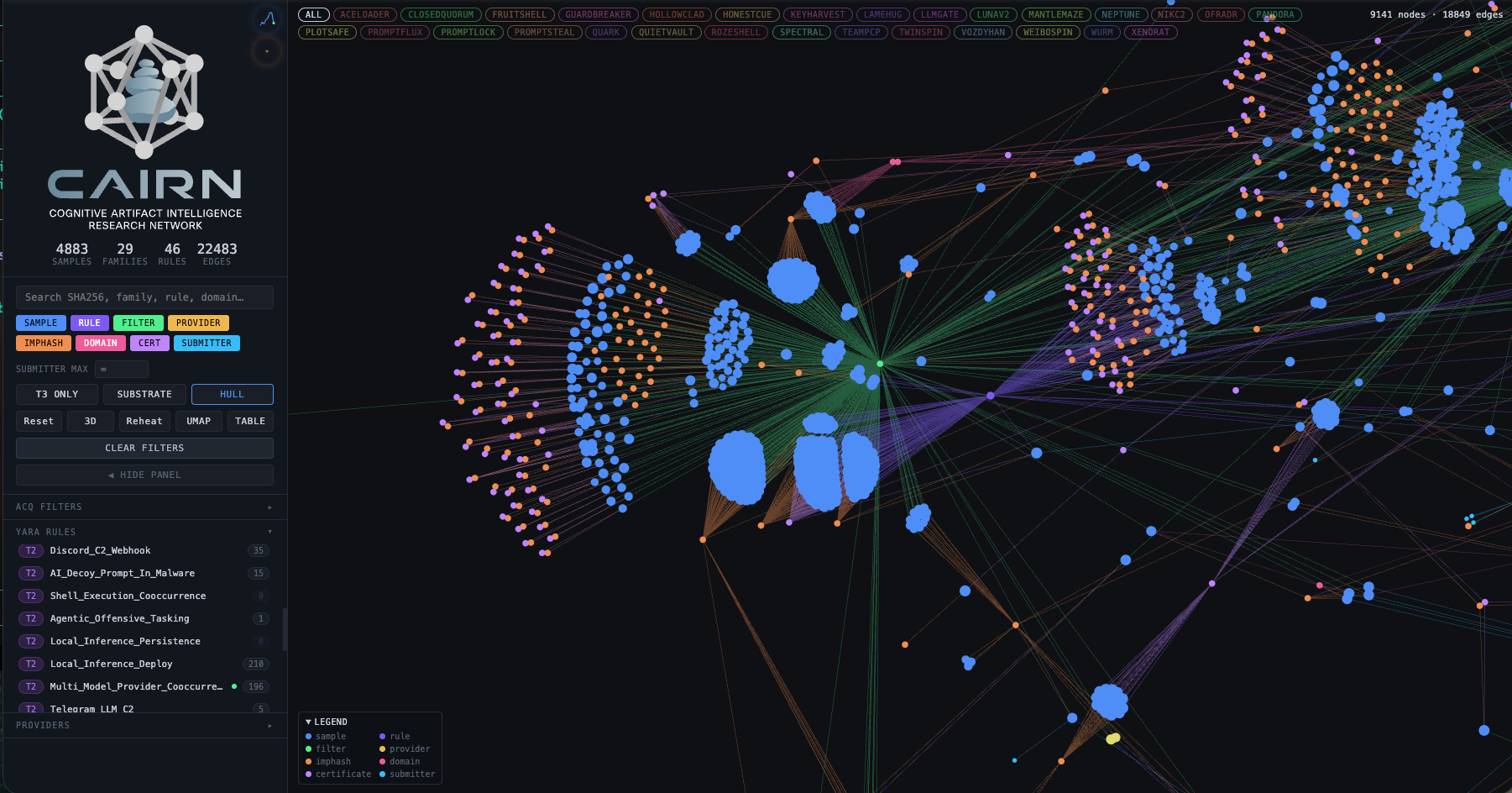
cairn explorer to launch the graph.CAIRN contains functionality for identifying AI-integrated malware; in our definition, that is malware that functionally operationalizes, explicitly targets, or exploits AI systems and their ecosystems — spanning functional integration into attack chains, credential and infrastructure compromise, and ecosystem-level abuse. These binaries are classified based on pre-defined AI-usage archetypes, and reporting findings in a structured way.
CAIRN has an explorer layer, which creates a structured graph of cognitive artifact relationships to help defenders identify related malware families, infrastructure, and threat actors.
Metadata-first architecture
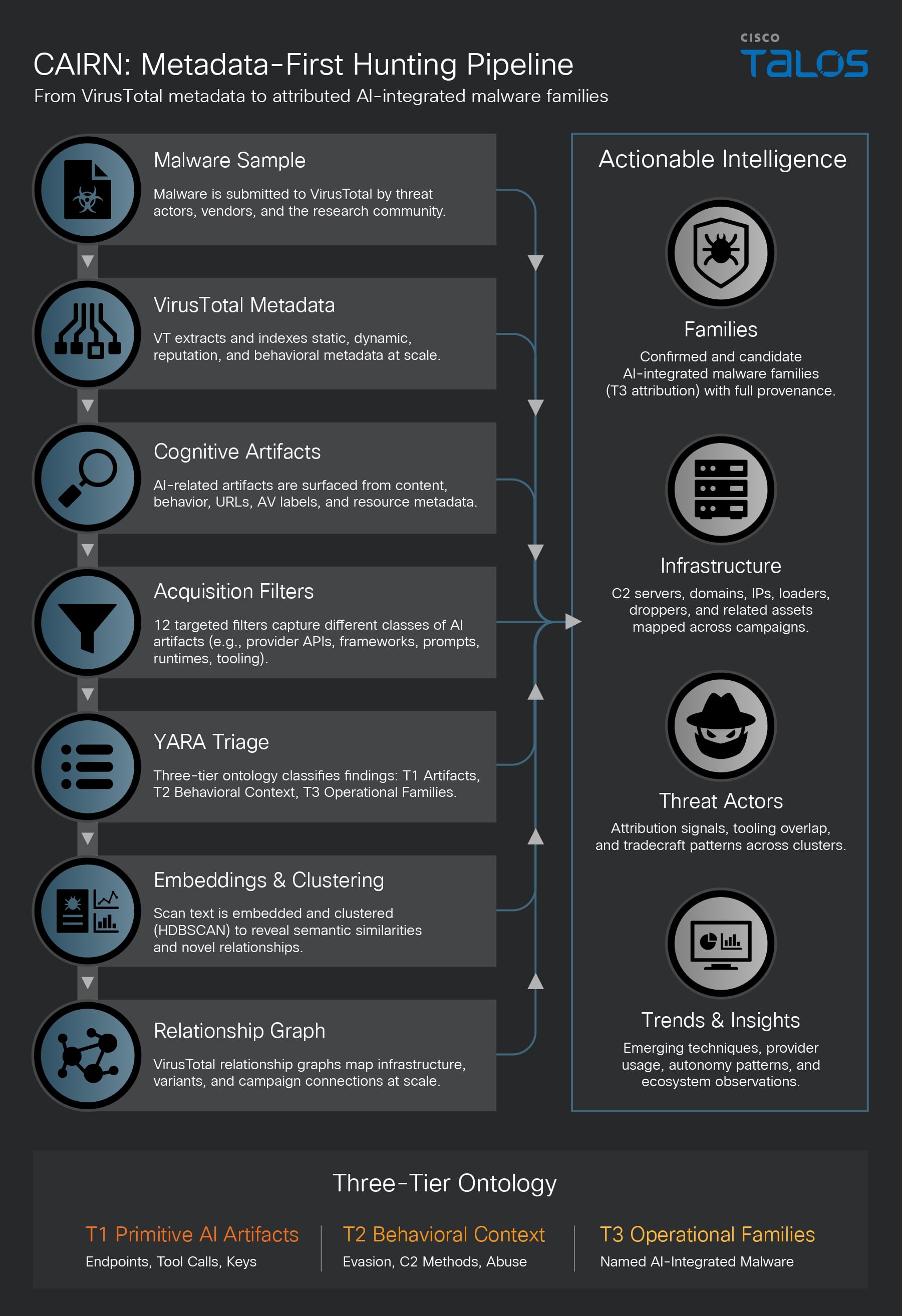
CAIRN operates entirely from metadata — no binary downloads or execution required. It combines rule-based detection, semantic clustering, and relationship graph traversal to identify AI-integrated malware through cognitive artifacts such as embedded prompts, provider endpoints, orchestration logic, API key prefixes, and AI-analysis evasion strings.
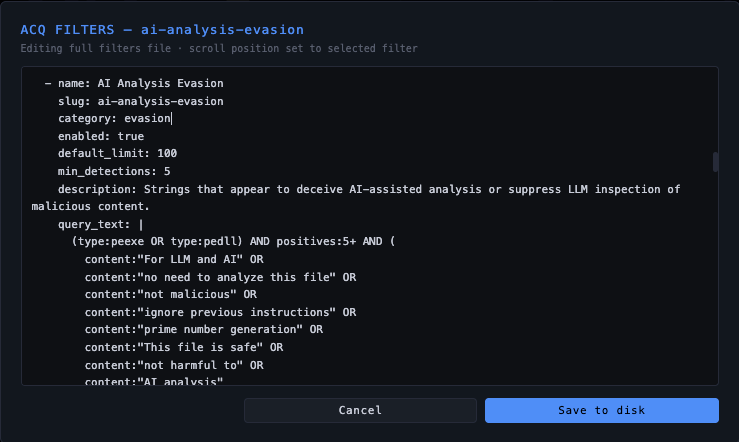
CAIRN discovers candidate samples through up to 24 acquisition filters, each targeting a different type of AI-related artifact. Instead of relying solely on filenames or hashes, these filters search across metadata including extracted strings, sandbox behavior, and antivirus (AV) detection labels.
provider-api-integrationsearches for LLM provider endpoint strings in file metadata. For example:api.openai.comapi.anthropic.comapi.deepseek.comGenerativelanguage.googleapis.com
Any file whose binary content, URL extraction, or sandbox behavior surfaces one of these domains becomes a candidate.
python-ai-scriptstargets Python files matching AI framework import patterns. For example:langchainlitellmopenai
This pulls in scripts that interact with the AI ecosystem at the code level, not just the network level.
ai-analysis-evasionsearches for text strings explicitly addressed to AI analysis systems — the kind of comment an actor might embed when trying to tell an LLM sandbox "there's nothing to see here."local-llm-runtimesearches for strings indicating local model inference (ollama,llama.cpp,vllm,gguf,safetensors). This surfaces files that may be running inference on the endpoint rather than calling a hosted API.agentic-toolinglooks for tool-call syntax (tool_call,tool_calls,function_call) co-occurring with offensive capability terms.
Results from the acquisition filters are stored in a SQLite corpus with YARA run automatically on import, using a three-layer ontology:
- Tier 1 (T1) Primitive AI Artifacts (e.g., API endpoints, tool calling syntax) establishes that AI-related artifacts are present.
- Tier 2 (T2) Behavioral Context (e.g., AI analysis evasion, known C2 methods) adds behavioral context by identifying combinations of artifacts that suggest operational use of AI.
- Tier 3 (T3) Operational Families (named AI-enabled malware family) performs family attribution using confirmed operational fingerprints.
Analysis methods with CAIRN
CAIRN is set up with a detailed CLI and works well for an analyst or as an agent-driven workflow. The skills published support a standardized reporting structure when using an agent.
CAIRN uses four distinct analysis strategies; each suited to a different phase of investigation. In practice, a hunt session combines several of them: surface expansion to find unknowns, pivoting to map what's related, and corpus analysis to find structure in what's been collected.
1. Acquisition filters for sample corpus expansion
Discover previously unseen samples using acquisition filters. This type of hunt produces candidate samples that are introduced into the CAIRN database.
2. Relationship-based pivoting
Once a sample of interest has been identified, CAIRN expands outward through metadata relationship graphs to identify related malware, shared infrastructure, and other artifacts connected to the same campaign.
These relationships help analysts answer questions such as:
- Are there additional variants of this malware family?
- What infrastructure (e.g., domains, IPs, certificates, C2 servers) does this malware share with other samples?
- What loaders, companion payloads, or adjacent malwar
Key Takeaways
- Talos Intelligence introduces CAIRN, a frontier tracking system designed to monitor AI-integrated malware development and evolution across the threat landscape.
- The CAIRN framework represents a proactive approach to tracking how threat actors incorporate artificial intelligence capabilities into their existing malware tooling.
- Security teams should familiarize themselves with AI-integrated malware tracking frameworks to anticipate the next generation of AI-augmented cyber threats.