Gaming the system: how a Chinese-speaking actor turned Brazilian government sites into an SEO weapon
September 2, 2026 · Check Point Research · Severity: MEDIUM
Research by: Amit Yardeni Key Points A Chinese-speaking actor is now targeting Brazil. Check Point Research has uncovered a sustained campaign against Brazilian organizations, primarily government and educational institutions since mid-2025.
Research by: Amit Yardeni
Key Points
- A Chinese-speaking actor is now targeting Brazil. Check Point Research has uncovered a sustained campaign against Brazilian organizations, primarily government and educational institutions since mid-2025. We dubbed this group Gambling Goblin: a Chinese-speaking cybercrime cluster connected to a previously documented group, Earth Berberoka, that targeted gambling sites across Asia. It marks a shift from Brazil’s usual home-grown banking-trojan threats to a foreign operator moving in
- Compromised web servers turned into stealthy proxies. The attackers compile and install malicious Apache modules on victim servers that silently reverse-proxy visitors to attacker-controlled phishing pages, while the traffic still appears to originate from the legitimate domain, with the site’s own security headers stripped so injected content runs freely.
- Large-scale SEO manipulation. The phishing pages pose as trusted app stores such as Google Play, Microsoft Store, and Amazon. Behind that facade, they push online gambling and sports betting, and they chain together compromised high-reputation domains, many of them Brazilian government sites, to inflate search rankings and hijack traffic at scale.
- A broad, heavily obfuscated Linux toolkit. Once inside a host, the group deploys custom tools – downloader (DownPro), multiple backdoors including the modular AlphaAgent and the oRAT RAT, a 3snake-based credential stealer, an SSH brute-forcer, and a plugin-driven reconnaissance agent. Most of them are wrapped in packing and virtualization layers to slow analysis and evade detection.
- The operation reaches well beyond Brazil. We identified parallel phishing networks localized in Vietnamese, Spanish, and English, alongside infrastructure that generates fresh domains daily – evidence the model is built to scale and be exported to new regions.
- One step from direct malware delivery. Because the pages already mimic app-download destinations, the same infrastructure sits a single configuration change away from pushing malware straight to victims, a latent escalation risk beyond the current search-fraud scheme.
Introduction
Since mid-2025, Check Point Research has tracked a sustained campaign against Brazilian organizations. The tradecraft points to a Chinese-speaking cybercrime group connected to Earth Berberoka, an actor first documented targeting gambling sites across Asia.
Once inside a victim, the group deploys a broad Linux toolkit: a custom downloader, several backdoors, and familiar offensive utilities. Most of it arrives heavily obfuscated – wrapped in layered virtualization and packing to slow analysis and evade detection.
The purpose becomes clear at the network layer. The attackers install custom Apache modules that quietly proxy visitors to a sprawling set of phishing pages. Many of those pages sit on Brazilian government domains that appear to have been compromised and repurposed without their owners’ knowledge.
The reach extends beyond Brazil. We uncovered a second phishing network run by the same actor; this one is built for Vietnamese victims.
The likely goal is SEO manipulation at scale. By hijacking trusted, high-reputation domains, many of them Brazilian government sites, the operators borrow that reputation to push their own content up the search rankings and hijack the traffic that follows. But the same infrastructure could serve a more dangerous end: the phishing pages impersonate app-download destinations such as Google Play, the Microsoft Store, and Amazon, which leaves the operators one step from pushing malware straight to victims.
Infection Flow
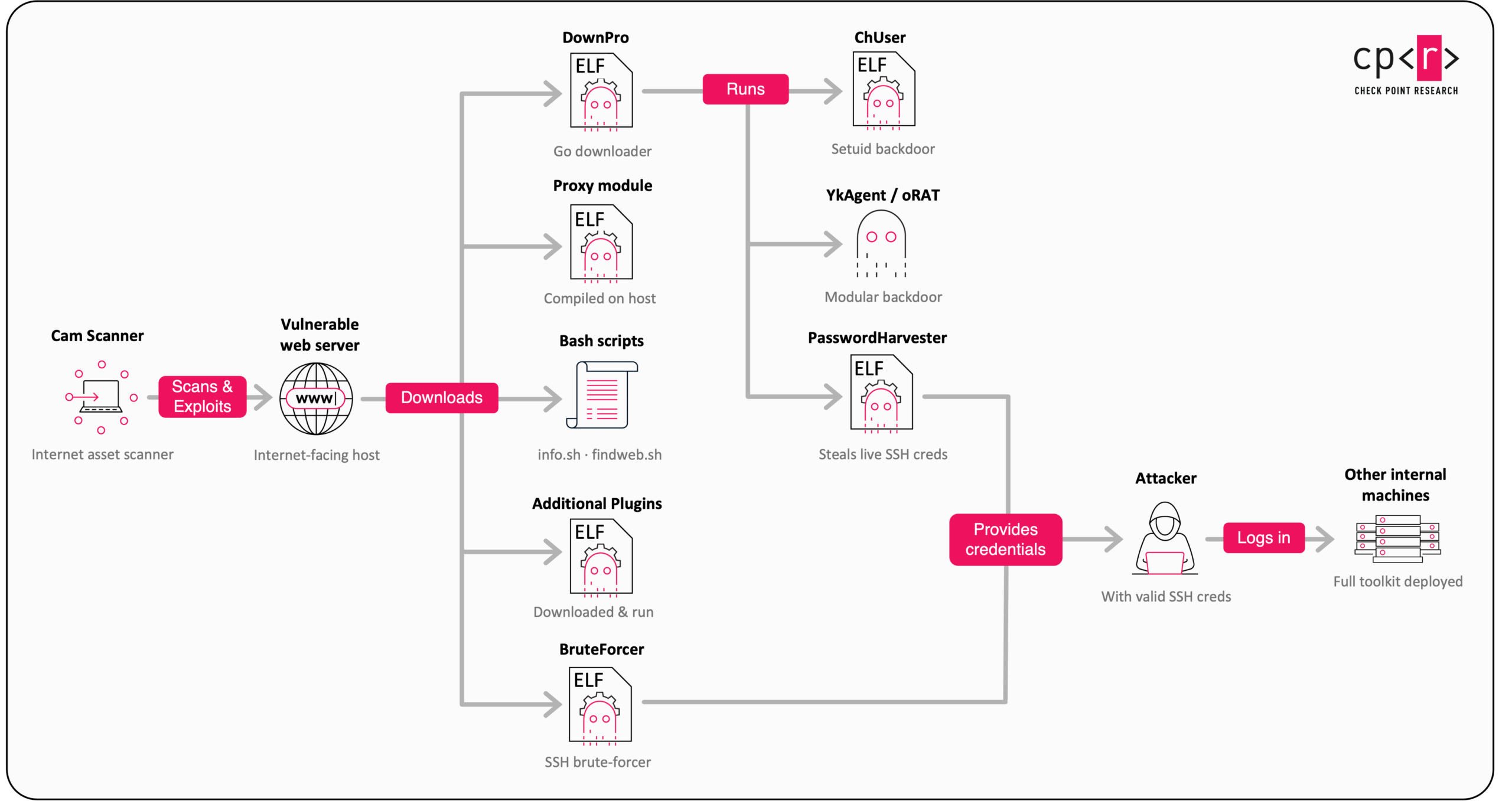
Initial Access
We have not directly observed this group’s initial access, but a revealing artifact surfaced on one of their servers: an exposed open directory hosting an ELF binary written in Go that bundles numerous reconnaissance and scanning plugins. The toolset reads like a complete attack-surface-mapping pipeline for internet-facing targets.
The group refers to this agent as “cluster-asset-mapping”, or “cam-agent” for short. It runs with a handful of flags:
- default – long-lived worker session for orchestrated task dispatch
- f – foreground mode without logging
- flog – enable logging (use with
f) - h – show help
- v – show version
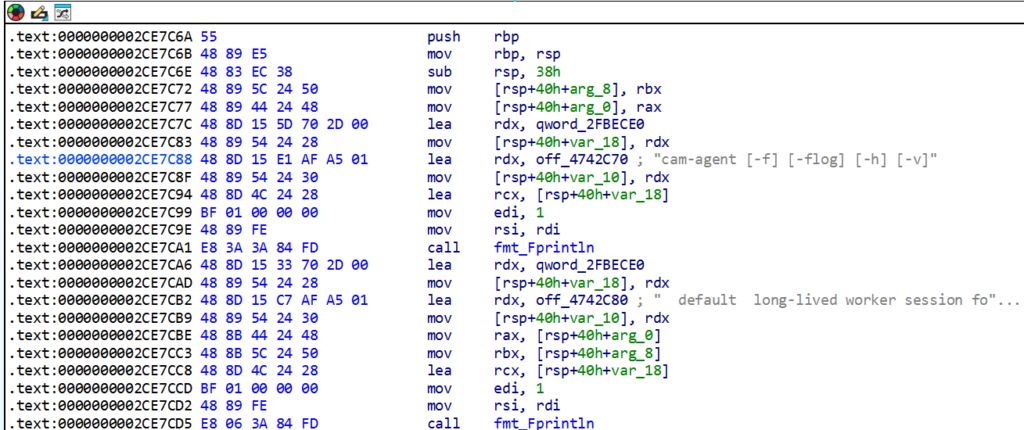
The agent carries a configuration that includes:
- worker_endpoint
- server_id
- project
- agent_token
- embedded PEM certificates and keys for the server and agent
- a plugin list
- report policies
It logs to payload-run.log under the default directory of /tmp/asset-scan. The agent reads the JSON report policies to decide how to run its scan. The policies are driven by the following fields:
- common web ports
- batch_size
- retry_count
- retry_backoff_seconds
- level

The agent communicates with its server over gRPC, authenticating with the certificates and keys from its own configuration. It uses many known open-source pentesting tools as modules:
- dirprobe – takes URLs and a directory list or profile, sends HTTP requests, and records the status code, response length, and title for each probed path.
- httpx – takes URLs, ports, and HTTP options, then collects the status code, response length, title, protocol, TLS details, and banners from each target.
- naabu – takes IPs or hostnames, port ranges, and a scan mode, attempts TCP connections across all targets, and marks each port as open, closed, or filtered.
- nuclei (v3) – takes URLs, paths, and workflows, executes HTTP/DNS/TCP checks as defined by templates, and emits a structured result for each match (template ID, severity, affected URL, evidence).
- subfinder – takes root domains, resolvers, and a depth, then enumerates subdomains via
Key Takeaways
- A Chinese-speaking threat actor turns Brazilian government websites into gaming platforms for cryptomining and resource abuse.
- Organizations should monitor for unauthorized resource usage and implement web application firewalls to prevent website compromise.
- Organizations should review the full article for complete details and implement relevant security measures.