From SQLi to RCE – Exploiting LangGraph’s Checkpointer
June 11, 2026 · Check Point Research · Severity: HIGH
Check Point Research uncovered three vulnerabilities in LangGraph, an open-source AI framework with over 50 million monthly downloads, which could allow attackers to execute remote code. The first flaw (CVE-2025-67644) is a SQL injection in the SQLite checkpointer that lets attackers inject malicious SQL queries through user-controlled filters, potentially leading to arbitrary deserialization of attacker-controlled data. The second vulnerability (CVE-2026-28277) involves unsafe deserialization of msgpack data, while a third issue (CVE-2026-27022) introduces similar injection risks in the Redis checkpointer. These flaws primarily affect teams self-hosting LangGraph with SQLite or Redis checkpointers where the get_state_history() function exposes user-controlled filters. LangChain has patched all three vulnerabilities, and users are advised to update to langgraph-checkpoint-sqlite 3.0.1+, langgraph 1.0.10+, or langgraph-checkpoint-redis 1.0.2+. The managed cloud service LangSmith Deployment (formerly LangGraph Platform) uses PostgreSQL and remains unaffected. These vulnerabilities are particularly concerning because LangGraph is widely used for building stateful AI systems, and successful exploitation could allow attackers to execute arbitrary code on vulnerable systems. The discovery highlights the importance of securing persistence layers in AI frameworks, especially when handling user-controlled inputs.
By Yarden Porat
AI agents need memory. Frameworks like LangGraph provide it through checkpointers – persistence layers that store execution state. But what happens when that persistence layer isn’t locked down?
Key Points
- Check Point Research analyzed LangGraph, an open-source framework for stateful AI agents with over 50 million monthly downloads, and uncovered three vulnerabilities in its persistence layer.
- Two of them chain into remote code execution: a SQL injection in the SQLite checkpointer (CVE-2025-67644) and an unsafe msgpack deserialization (CVE-2026-28277).
- A third, parallel issue (CVE-2026-27022) introduces the same injection class into the Redis checkpointer.
- Who’s at risk: teams self-hosting LangGraph with the SQLite or Redis checkpointer, where the application exposes
get_state_history()with a user-controlledfilter. LangChain’s managed cloud service, LangSmith Deployment (formerly LangGraph Platform), runs PostgreSQL and is not vulnerable.
- LangChain patched all three issues. Users should update to
langgraph-checkpoint-sqlite 3.0.1+,langgraph 1.0.10+, andlanggraph-checkpoint-redis 1.0.2+.
Background
LangGraph is an open-source framework for building stateful, multi-agent AI systems with built-in persistence. It’s an extension of LangChain, with over 50 million monthly downloads according to PyPI stats.
Checkpointers are LangGraph’s persistence layer that stores execution state at each step. LangGraph supports two checkpointer implementations: SQLite and PostgreSQL.
Vulnerability #1: SQL Injection (CVE-2025-67644)
The SQLite Checkpointer Database Schema:
The SQLite checkpointer uses an internal table called checkpoints with the following structure:
CREATE TABLE checkpoints (
    thread_id TEXT NOT NULL,
    checkpoint_ns TEXT NOT NULL DEFAULT '',
    checkpoint_id TEXT NOT NULL,
    parent_checkpoint_id TEXT,
    type TEXT,
    checkpoint BLOB,
    metadata BLOB,
    PRIMARY KEY (thread_id, checkpoint_ns, checkpoint_id)
);
The metadata column stores additional contextual information about each checkpoint in JSON format. For example:
{
  "user_id": "alice",
  "step": 1,
  "source": "input"
}
The list() Function and Filtering:
When calling the list() function on sqliteSaver (the checkpointer), the filter parameter is used to query checkpoints based on their metadata:
def list(
    self,
    config: RunnableConfig | None,
    *,
    filter: dict[str, Any] | None = None,  # Used to filter by metadata
    before: RunnableConfig | None = None,
    limit: int | None = None,
) -> Iterator[CheckpointTuple]:
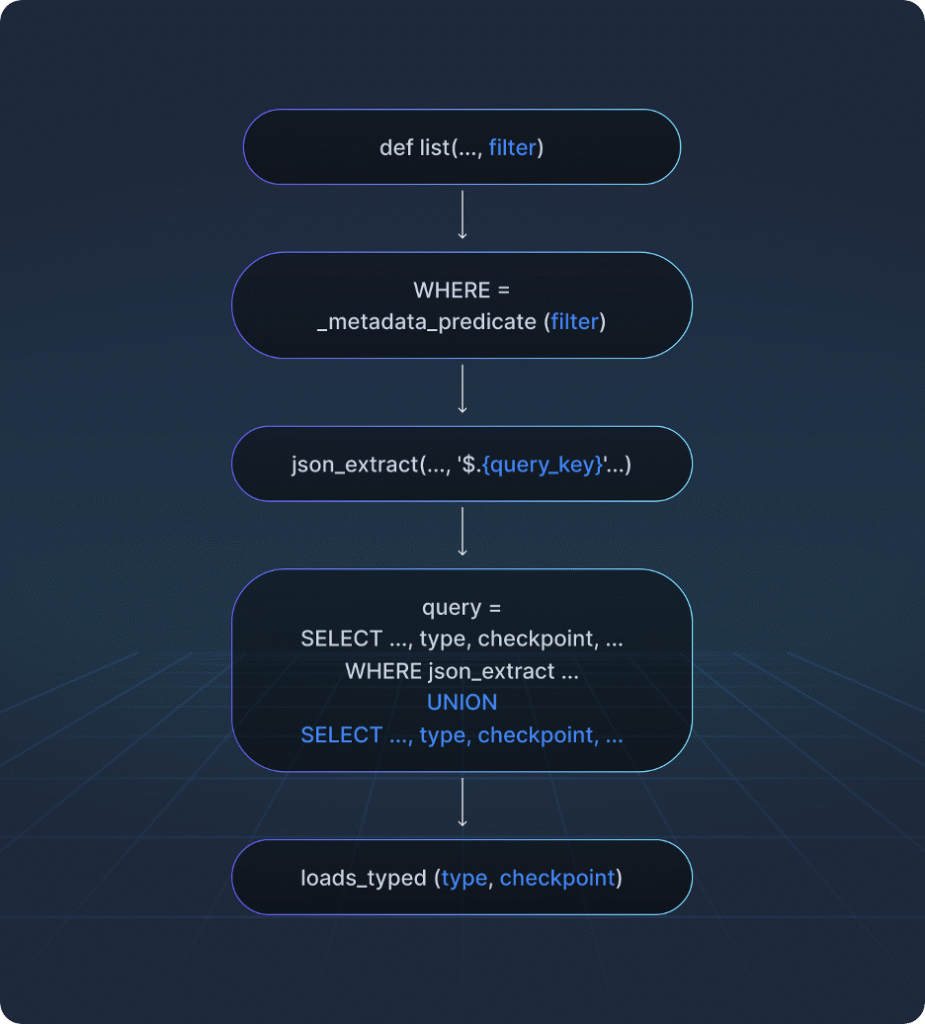
The filter parameter is passed to an internal function called _metadata_predicate, which constructs the SQL WHERE clause to query checkpoints by their metadata fields.
# process metadata query
    for query_key, query_value in filter.items():
        operator, param_value = _where_value(query_value)
        predicates.append(
            f"json_extract(CAST(metadata AS TEXT), '$.{query_key}') {operator}"
        )
        param_values.append(param_value)

    return (predicates, param_values)
The Injection
The vulnerability exists in how _metadata_predicate handles the query_key from the filter dictionary.
Notice this critical line:
f"json_extract(CAST(metadata AS TEXT), '$.{query_key}') {operator}"
An attacker-controlled filter could provide a query_key with a ' character that will escape the JSON path string and inject arbitrary SQL code.
Injection -> Arbitrary Deserialization
To understand how SQL injection leads to arbitrary deserialization, we need to see the complete picture.
Here’s the SQL query that gets executed in list():
query = f"""SELECT thread_id, checkpoint_ns, checkpoint_id, parent_checkpoint_id, type, checkpoint, metadata
FROM checkpoints
{where}
ORDER BY checkpoint_id DESC"""
This query retrieves checkpoint data from the database, including the checkpoint’s BLOB column.
The results are then processed:
async for (
    thread_id,
    checkpoint_ns,
    checkpoint_id,
    parent_checkpoint_id,
    type,
    checkpoint,  # ← This comes directly from the SQL query results
    metadata,
) in cur:  # ← cur contains the query results
    # ...
    yield CheckpointTuple(
        # ...
        self.serde.loads_typed((type, checkpoint)),  # ← Deserialization
        # ...
    )
The checkpoint contains serialized data, and when fetched gets deserialized.
The Attack
Using SQL injection in the WHERE clause, an attacker can inject a UNION SELECT that adds their own row to the query results:
SELECT thread_id, checkpoint_ns, checkpoint_id, parent_checkpoint_id, type, checkpoint, metadata
FROM checkpoints
WHERE ... (injected: ') UNION SELECT 'thread1', 'ns', 'checkpoint1', NULL, 'msgpack', X'', '{}' -- )
ORDER BY checkpoint_id DESC
The injected UNION SELECT returns a fake checkpoint row where the checkpoint column contains attacker-controlled serialized data. When the code loops through the query results, it deserializes this malicious checkpoint’s BLOB, giving the attacker arbitrary deserialization
Vulnerability #2: MsgPack Unsafe Deserialization (CVE-2026-28277)
Now let’s examine what happens during deserialization. The self.serde.loads_typed() function that deserializes checkpoint data looks like this:
def loads_typed(self, data: tuple[str, bytes]) -> Any:
    type_, data_ = data
    if type_ == "null":
        return None
    elif type_ == "bytes":
        return data_
    elif type_ == "bytearray":
        return bytearray(data_)
    elif type_ == "json":
        return json.loads(data_, object_hook=self._reviver)
Key Takeaways
- By Yarden Porat AI agents need memory.
- Frameworks like LangGraph provide it through checkpointers persistence layers that store execution state.
- but what happens when that persistence layer isnt locked down?