Don’t swing at everything
July 23, 2026 · Talos Intelligence · Severity: MEDIUM
This article is a Threat Source newsletter that reflects on the current state of AI in cybersecurity, describing a shift from a 'pre-Mythos' to a 'post-Mythos' era. It highlights the rapid advancement of AI models, including open-weight options like GLM-5.2, which are closing the capability gap with closed models. The author suggests that the buffer zone between vulnerability discovery and publication may be ending, as indicated by recent Patch Tuesday signals.

Welcome to this week’s edition of the Threat Source newsletter.
Lately I've found myself thinking a lot about the Australian TV series Mr. Inbetween (IMDb 8.7/10) — not because I'm a hitman for hire, but because I literally feel in-between. Specifically, in-between what I'd call the "pre-Mythos" and “post-Mythos” eras. We've crossed a capability threshold, and it's not just one model family driving that — Codex 5.3 and GPT-5.5 deliver comparable or better performance, and Tulongfeng or GLM-5.2 (an incredibly powerful open-weight model, MIT-licensed) show the frontier isn't limited to closed models anymore.
On the other side of that line, real-world impact hasn't caught up yet and we're living in an artificial buffer zone. For me, defining the “pre-” and “post-” status comes down to the gap between "vulnerability discovery" and "vulnerability publication."
Last week’s Patch Tuesday gave a signal of change, as Joe pointed out, so maybe the buffer zone has come to an end.
Let's dive into the 2026 Q2 stats.
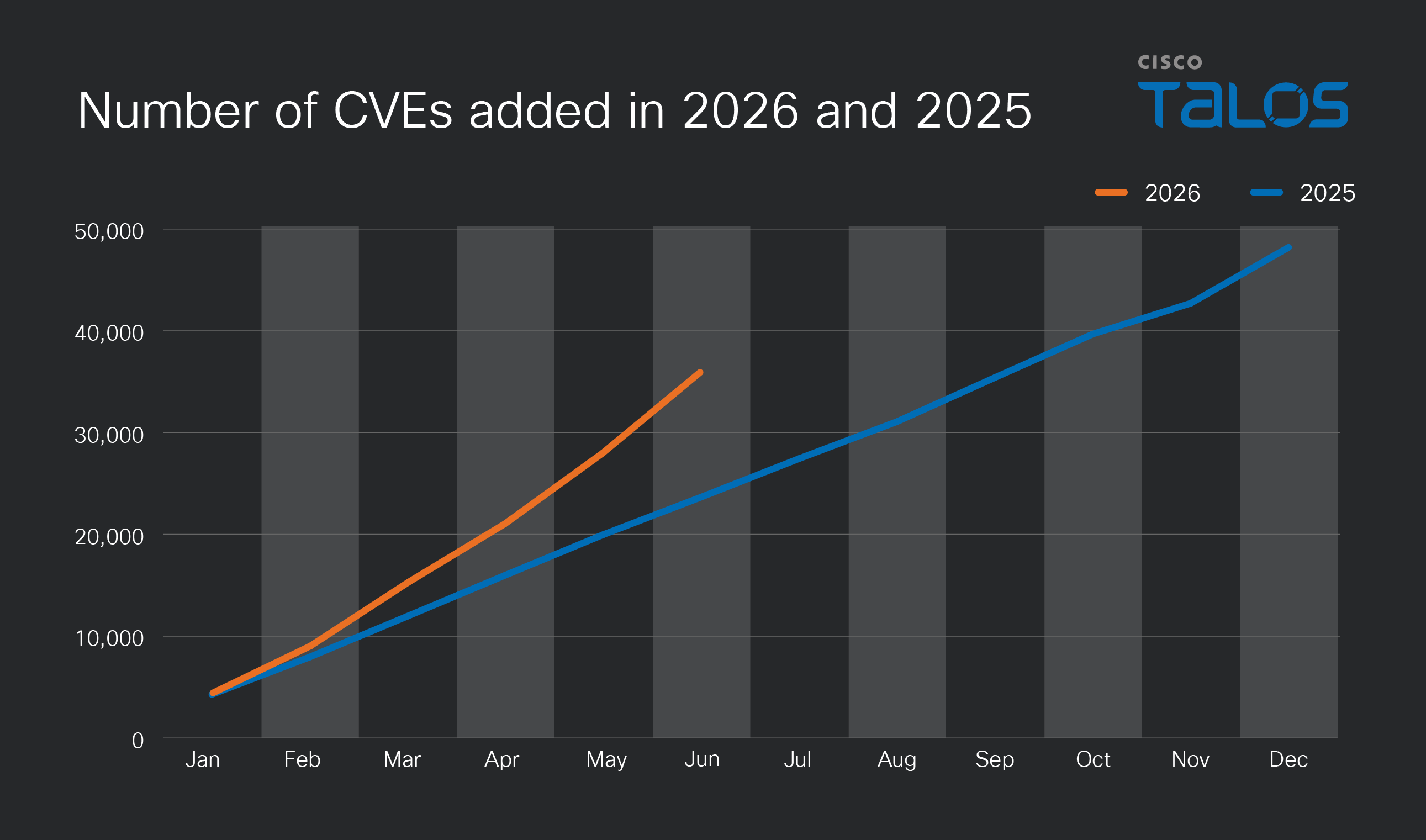
As in past years, we're seeing a steeper curve than the year before — a solid 49% YoY growth, though still not the hockey-stick moment I keep waiting for. By the end of June we were tracking close to 200 CVEs per day.
Using the keyword methodology described here, I found 452 AI-related CVEs this calendar year. If "openclaw" is added to the keyword list, that number jumps by another 536 — a reminder that these counts are sensitive to keyword drift. Given how much the keyword list keeps changing, I'm reconsidering whether to keep publishing this particular metric going forward.
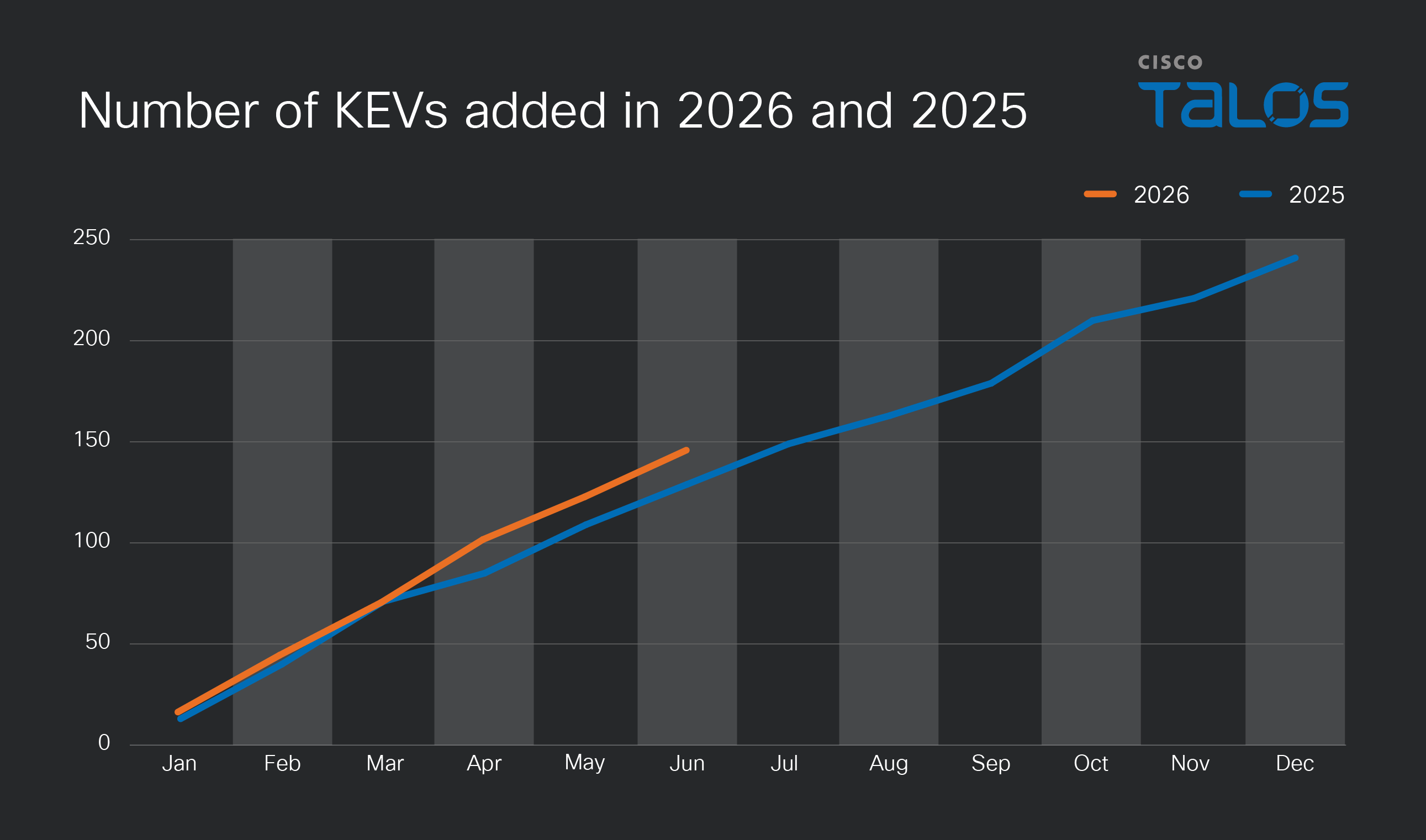
KEVs, by contrast, "only" grew 13% — a small April spike aside, it's fairly flat relative to total CVE growth. Networking-gear-related CVEs continued their climb, now accounting for 24% of KEV-related vulnerabilities (up from 20% in Q1) — consistent with the trend I flagged last quarters.
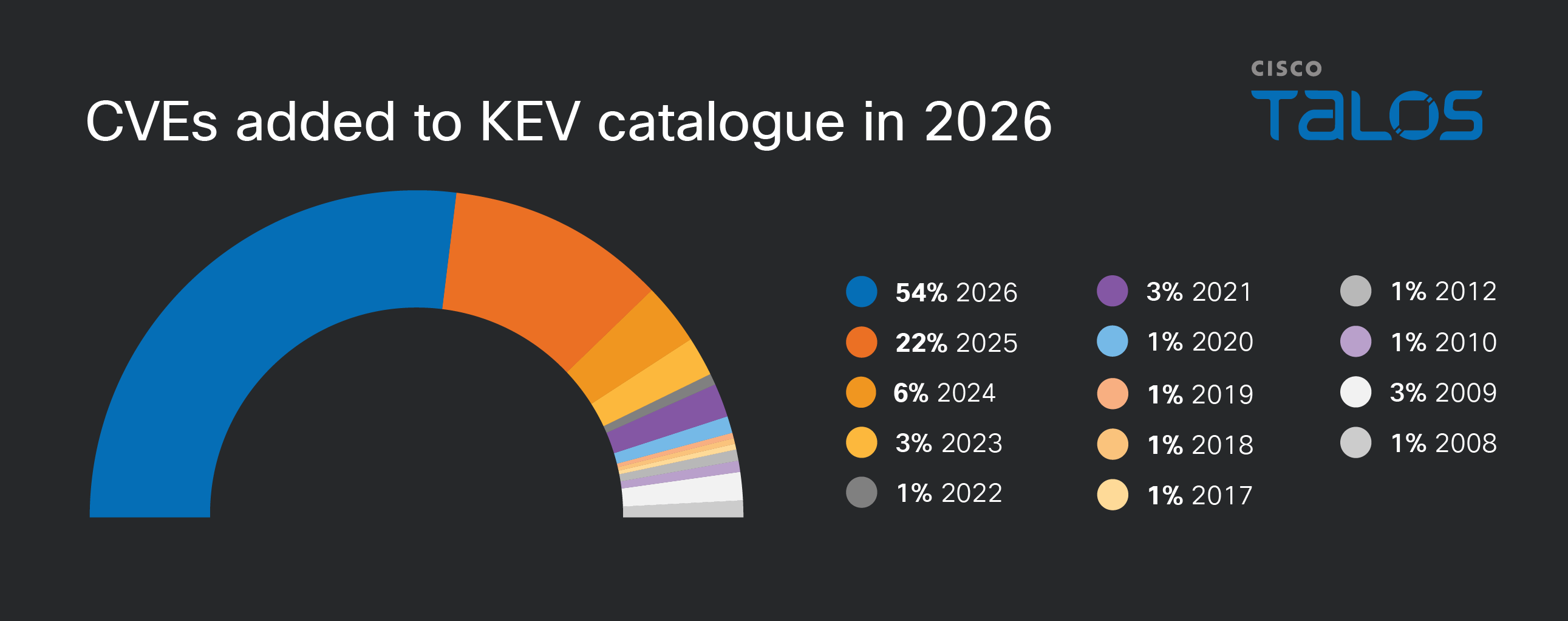
As in previous quarters, CVEs from 2024 or earlier still make up about 24% of everything we're tracking. More strikingly, even though the standard enterprise patch cycle is described to run 30–90 days, 181 days into 2026, 46% of today's actively-exploited (KEV) CVEs still trace back to 2025 or earlier.
Old vulnerabilities don't retire, new ones keep arriving, and machine-speed vulnerability discovery is going to keep outpacing human-speed patching. Which brings me back — once again — to EPSS as a tool for prioritizing patching against this dataset.
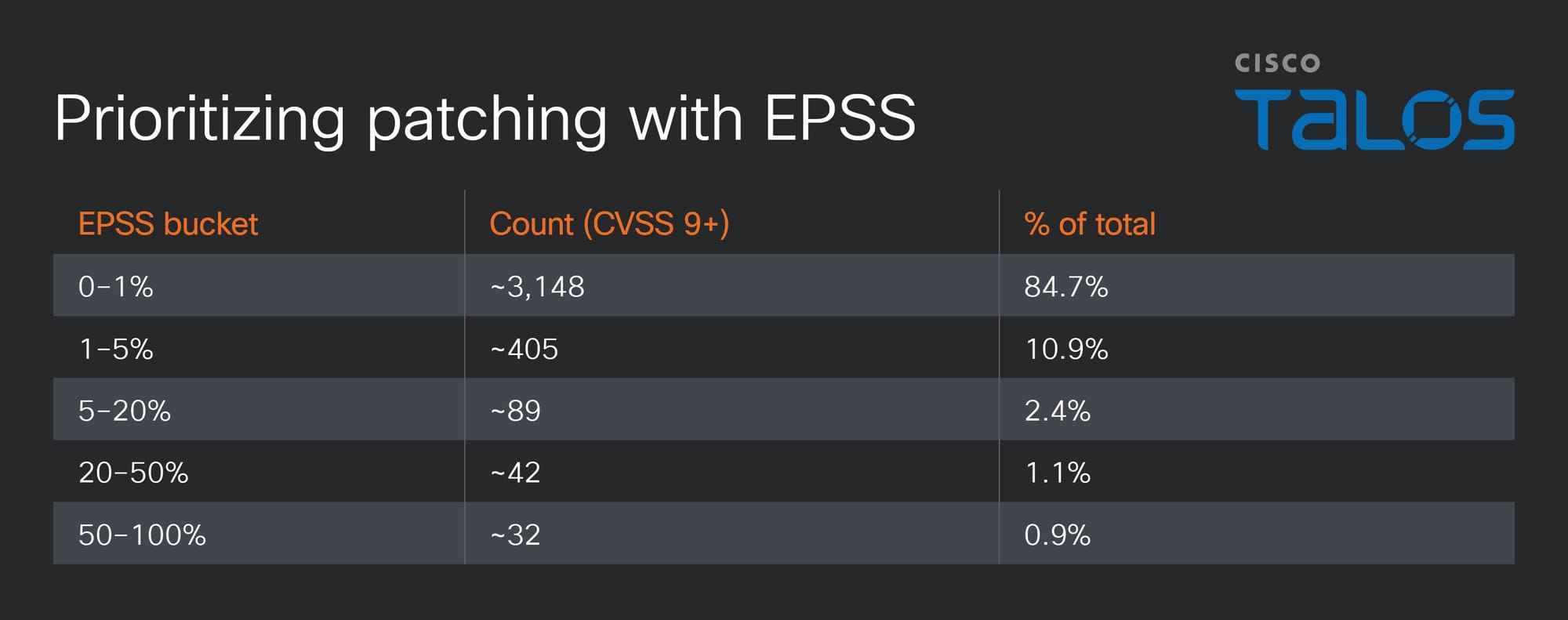
If you patched purely by CVSS 9+, you'd be urgently chasing ~3,700 CVEs — but 95% of those sit below 5% EPSS, meaning the real-world odds of exploitation are tiny.
Of the 32 CVSS 9+ CVEs with EPSS ≥ 50%, 25 are already on CISA's KEV list. The remaining seven outliers are still high-probability by EPSS but haven't made KEV yet — worth watching.
Ray Shoesmith (Mr. Inbetween) once told his therapist, "You know, if I hit somebody, I generally got a pretty good reason."
Same principle applies to patching. Don't swing at everything — swing at what you have good reason to believe is coming for you.
The one big thing
Cisco Talos has discovered "msaRAT," a new Rust-based remote access trojan (RAT) deployed by the Chaos ransomware group. Built on the Tokio asynchronous runtime, it establishes a covert command-and-control (C2) channel by hijacking Chrome or Edge browsers via the Chrome DevTools Protocol (CDP). The infection starts with a deceptive MSI file masquerading as a Windows update that loads the payload directly into memory, paving the way for ransomware deployment.
Why do I care?
This RAT is a master of evasion, living off the browser to build its C2 infrastructure without ever directly touching the network. By routing traffic through legitimate browser processes and trusted services, msaRAT easily bypasses traditional network-based detections. Additionally, its use of the Tokio runtime enables highly efficient, parallel execution of malicious tasks, accelerating the attacker's ability to establish persistence and deploy double-extortion ransomware.
So now what?
Defenders should monitor for unusual curl commands, especially those downloading MSI files to the ProgramData directory or sending plain HTTP traffic over port 443. Scrutinize unexpected MSI files impersonating Windows updates and watch for unauthorized Chrome or Edge manipulation. Finally, implement behavioral monitoring to catch Chrome DevTools Protocol abuse and unauthorized WebRTC connections. Read the full blog for complete coverage and indicators of compromise (IOCs).
Top security headlines of the week
Introducing Antares: Highly efficient open weight AI models for vulnerability localization
This week, Cisco introduced Antares, a family of security small language models (SLMs) purpose-built for pinpointing where known vulnerabilities exist within a codebase. (Key Takeaways