China-nexus UAT-11587 targets government and policy organizations across Asia with Antino backdoor
September 30, 2026 · Talos Intelligence · Severity: MEDIUM
Cisco Talos uncovered a cluster of activity we track as UAT-11587 targeting government and policy organizations across Asia, including in Taiwan, India, the Philippines, and Cambodia, to deliver a previously undocumented backdoor referred to as “Antino” in developer artifacts. Talos first observed UAT-11587 activity in September 2025. By July 2026, Talos had identified at least 16 affected or targeted institutional environments across eight Asian countries. Antino is a Rust-compiled Windows backdoor that supports host reconnaissance, shell and PowerShell execution, file transfer, in-memory she.
- Cisco Talos uncovered a cluster of activity we track as UAT-11587 targeting government and policy organizations across Asia, including in Taiwan, India, the Philippines, and Cambodia, to deliver a previously undocumented backdoor referred to as “Antino” in developer artifacts.
- Talos first observed UAT-11587 activity in September 2025. By July 2026, Talos had identified at least 16 affected or targeted institutional environments across eight Asian countries.
- Antino is a Rust-compiled Windows backdoor that supports host reconnaissance, shell and PowerShell execution, file transfer, in-memory shellcode loading and persistence. Its native command-and-control channel operates exclusively through Microsoft 365, using Microsoft Graph to interact with Outlook and OneDrive.
- Talos identified a recurring delivery branch that began with spear-phishing emails and tailored decoy documents, followed by a five-stage infection chain. The actor relied heavily on Cloudflare infrastructure for delivery, execution tracking, and payload staging.
- Based on the development, preparation-environment, and targeting indicators detailed in this report, Talos assesses with high confidence that UAT-11587 is China-nexus.
Overview

Talos first identified UAT-11587’s campaign while investigating a spear-phishing campaign directed at Taiwan's academic, think tank, and civil society policy community in March 2026. The message recreated Gmail's attachment interface and directed the target into a cloud-hosted, multi-stage infection chain.
Across this activity, our researchers assessed that the actor used several delivery methods, loader families, and post-compromise tools. One recurring final-stage payload was a custom Rust backdoor that Talos tracks as Antino. Antino communicates with Microsoft 365 applications and uses Outlook and OneDrive objects as dead drops, rather than depending on a conspicuous dedicated command server.
Further investigation showed that the activity extended beyond the initial Taiwan operation. Talos subsequently identified confirmed or probable affected government and security environments across multiple Asian countries, alongside additional regional targeting supported by lure content.
While this report was being prepared, Symantec published research on an activity set it tracks as Jewelbug. Talos identified overlaps between UAT-11587 and the Antino-related espionage activity attributed to Jewelbug. Although Symantec reported that Jewelbug conducted both espionage and cryptocurrency fraud, it assessed that “the SEO business supplied access, delivery and infrastructure into the espionage operation, rather than that one person performed both roles.” Talos could not independently verify a connection between the espionage campaign and Jewelbug’s financially motivated activity. We therefore track UAT-11587 as a separate activity set.
Who is UAT-11587?
Talos assesses with high confidence that UAT-11587 is a China-nexus actor, based on the totality of corroborating technical and operational evidence, rather than any single indicator. The indicators discussed below are selected examples of the broader evidence supporting this assessment.
Evidence supporting the attribution assessment
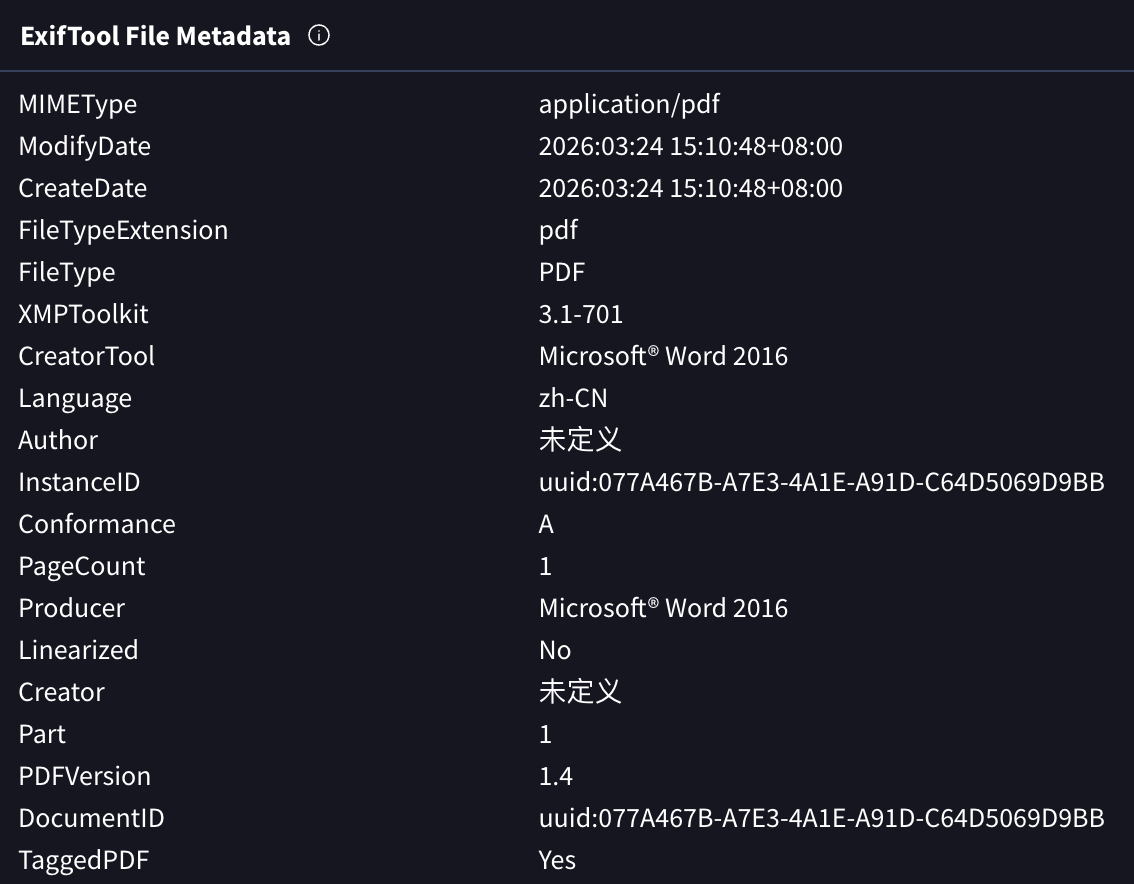
Decoy document metadata provides several preparation-environment clues. A Taiwan-focused decoy contains the zh-CN language tag, the Simplified Chinese author value 未定义 (“undefined”), and an explicit +08:00 creation timestamp. Both recovered spear-phishing messages also contain +08:00 date headers. UTC+8 alone is not geographically distinctive because it is used across mainland China, Taiwan, Hong Kong, Singapore, and other locations. However, the combination of the +08:00 offset, the zh-CN language tag and Simplified Chinese metadata is more consistent with a mainland Chinese environment than with Taiwan or Hong Kong, where Traditional Chinese predominates.
The campaign’s lure theme and targeting provide additional contextual support. Its lures and observed targets include Taiwanese political, legislative, civil defense, and policy research subjects, together with regional government, maritime, diplomatic, and security themes. This collection focus is consistent with China-nexus actor interests.
Another supporting indicator appears in Antino’s development artifacts. Ten distinct Antino build outputs contain Cargo registry paths referencing rsproxy.cn, a Rust package mirror intended to improve dependency downloads within mainland China. The service’s public accessibility does not reveal the developer’s location, but its repeated use suggests reliance on a China-focused Rust mirror.
During our investigation, Talos also identified a JavaScript downloader associated with UAT-11587 that referenced “d32tpl7xt7175h[.]cloudfront[.]net”, the same CloudFront distribution previously reported by Arctic Wolf in China-nexus UNC6384 delivery activity. This shared infrastructure suggests possible delivery-layer overlap. However, because cloud infrastructure can be reused and the campaigns employed different core malware and command-and-control (C2) architectures, Talos assesses this relationship with low confidence and continues to track UAT-11587 as a separate activity cluster.
Victimology
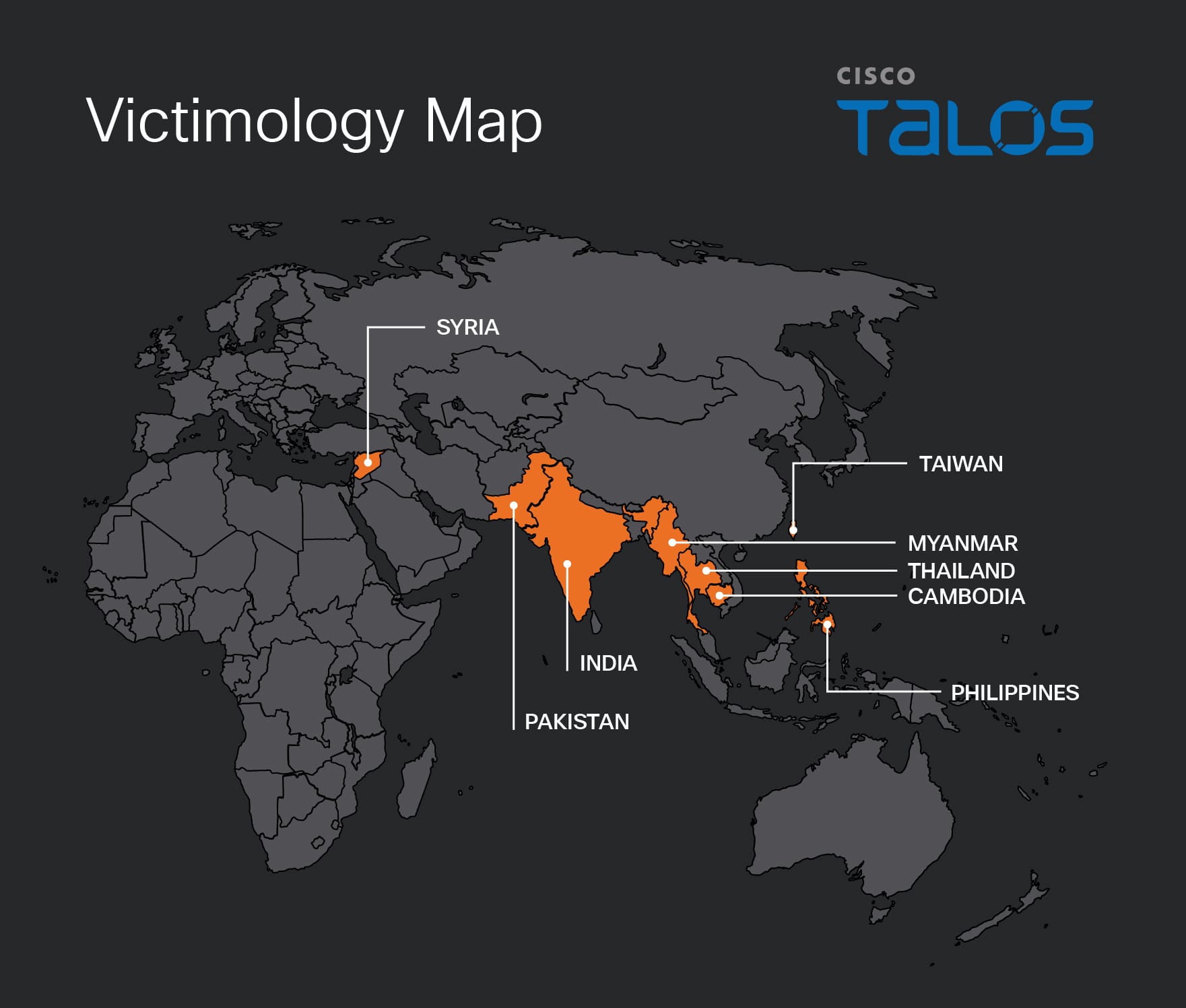
UAT-11587 primarily targeted public-sector and national-security-adjacent organizations across Asia. By July 2026, Talos had identified at least 10 confirmed and five probable affected institutional environments, plus one additional intended target. Our investigation reveals approximately 350 compromised endpoints across eight countries.
The affected or targeted sectors included:
- Defense, military, and national security
- Executive government and central public administration
- Foreign affairs and diplomatic services
- Justice, law enforcement, border security, and interior security
- Legislative and parliamentary institutions
- Government IT and shared e-government services
- Think tanks, universities, and research institutions
- Civil society, human rights, and public policy organizations
Based on the available evidence, Talos assesses with moderate-to-high confidence that the campaign targeted organizations in Taiwan, India, the Philippines, Cambodia, Pakistan, Thailand, Myanmar, and Syria.
Based on its sustained targeting of government and national security-adjacent organizations, tailored political and diplomatic lures, and capabilities supporting persistent access and information collection, Talos assesses with moderate confidence that UAT-11587 is conducting intelligence gathering operation.
Campaign timeline
Talos obs
Key Takeaways
- According to Talos Intelligence, this development warrants attention from teams monitoring the evolving threat landscape.
- Security teams should review their exposure and implement appropriate defensive controls.
- Security teams should review their exposure and implement appropriate defensive controls.