Breaking the Seal: Static Deobfuscation of JSCeal’s Compiled V8 Bytecode
August 31, 2026 · Check Point Research · Severity: LOW
Research by: hasherezade Key Points Since early 2025, Check Point Research has been tracking JSCeal, a sophisticated cryptocurrency-focused stealer with broader credential-theft, surveillance, and traffic-interception capabilities, delivered as compiled V8 bytecode (JSC files). The payloads are protected with javascript-obfuscator , using multiple techniques including RC4-protected strings, control-flow flattening, proxy functions, and operation wrappers.
Research by: hasherezade
Key Points
- Since early 2025, Check Point Research has been tracking JSCeal, a sophisticated cryptocurrency-focused stealer with broader credential-theft, surveillance, and traffic-interception capabilities, delivered as compiled V8 bytecode (JSC files).
- The payloads are protected with javascript-obfuscator, using multiple techniques including RC4-protected strings, control-flow flattening, proxy functions, and operation wrappers.
- Our goal was to recover the code to a level that enables detailed analysis, comparison between samples, and tracking of the malware’s evolution.
- CPR developed a fully static deobfuscation pipeline that transforms View8 pseudocode without executing the malware. An optional LLM-assisted renaming stage can then be used to make large, recovered codebases easier to navigate.
- The complete toolkit is publicly available at jsc_deobfuscator.
- The deobfuscated output enabled detailed analysis of JSCeal’s capabilities and their implementation, including keylogging, browser and credential theft, and HTTPS traffic interception through a local MITM proxy.
- We presented this research at Black Hat USA 2026. This article complements the talk by documenting the methodology in greater technical depth and providing additional examples and implementation details.
- We conclude with a brief look at more recent JSCeal developments, including V8 code caches generated for a newer Node.js/V8 version, an additional payload-encryption layer, and macOS targeting.
Introduction
JSCeal is a stealer delivered as compiled V8 bytecode (.jsc) and executed by a bundled Node.js runtime, targeting cryptocurrency applications (other vendors also tag it with the names WEEVILPROXY or MeadowLocust). Its campaign activity dates back to March 2024 [1]; Check Point Research has been tracking the malware since early 2025. Our previous publication from July 2025 [1] focused on the campaigns, delivery chain, and targeting. In this article, we focus on the analysis problem hidden inside the final payload.
Unlike ordinary JavaScript malware, JSCeal reaches the analyst after two transformations have already removed much of the information that source-oriented tools depend on. First, the JavaScript is heavily obfuscated. Then it is compiled into V8’s internal bytecode representation and shipped as cached data rather than source code. The resulting format is version-specific, poorly served by mature reverse-engineering tooling, and unsuitable for most standard JavaScript deobfuscation workflows.
From the attacker’s perspective, this combination is attractive because it is inexpensive to produce. Node.js and its package ecosystem provide ready-made building blocks for complex applications, while public tools such as javascript-obfuscator [6] can add several layers of source-level obfuscation before compilation. The analyst receives only the compiled artifact.
In 2024, our colleague Moshe Marelus published View8, an open-source decompiler for V8 bytecode [2]. We used it as the foundation for a static deobfuscation pipeline tailored to the patterns found in JSCeal. During this work, we extended View8 [3] to make its output reproducible and suitable for automated post-processing, and implemented dedicated passes for value propagation, string reconstruction, control-flow unflattening, proxy and operation-wrapper resolution, and additional cleanup.
The goal is not perfect source recovery — V8 compilation is lossy, and the output of decompilation remains pseudocode. Instead, we aimed to recover enough structure and semantics to read the malware as code again: follow its logic, compare samples, locate capability branches, and validate behavior against concrete strings, APIs, paths, and data flow.
Later in the article, we use one selected JSCeal payload as a case study and walk through portions of the recovered code, including browser and cryptocurrency theft, keylogging, screenshot capture, and a local HTTPS interception proxy.
Distributed payloads
Let’s start by understanding the role of the JSC files in the whole attack chain.
The payloads were delivered in campaigns that began with malvertising and were followed by multiple PowerShell scripts. The complete flow is illustrated below:
![Figure 1 - The final stage infection flow (image first presented in [1])](https://research.checkpoint.com/wp-content/uploads/2026/08/DJH5792K42-image1.png)
The last stage consists of two ZIP archives downloaded by PowerShell:
- node.zip – a packaged Node.js runtime
- build.zip, containing the final payload and supporting components:
winpty-agent.exe– an agent for a hidden Windows console (open source)winpty.dll– a module that allows interaction with the hidden console (open source)app.jsc– The JSCeal malware payloadpreflight.js– a decompression script- Native
.nodemodules (PE format) used by the payload
The final JSC payload is distributed in Brotli-compressed [5] form and decompressed by preflight.js.
The loading is triggered by the last PowerShell script in the chain, containing the command line:
.\node.exe -r .\preflight.js .\app.jsc (the option -r forces Node to run a JS file before loading the main module).
The size and complexity of the JSC payloads varied. They were all obfuscated with the same open-source obfuscator [6].
Analysis methodology
While typical analysis procedures were sufficient for the earlier stages, the final JSC payload remained challenging. Because it was delivered as a V8 code cache rather than JavaScript source, conventional source-level JavaScript instrumentation was not directly applicable. Native-level hooking and dynamic binary instrumentation (DBI) could reveal process and API activity, but did not recover the payload’s JavaScript-level semantics at a useful level. Sandbox execution therefore provided mainly low-level system-interaction telemetry. To understand the payload’s logic, we turned to static analysis, which required deobfuscation.
Since the JSC payload is Brotli-compressed, the first step is to remove this layer. This yields the V8 code cache, which can then be supplied to a compatible disassembler. The disassembled output is then passed to the View8-based pipeline, which includes decompilation and transformation by multiple deobfuscation passes. Each pass can be used as a self-contained script. To support modularity, we extended View8 with pickle serialization of its internal object graph. We also added function-level visibility controls and metadata annotations (details in Appendix A).
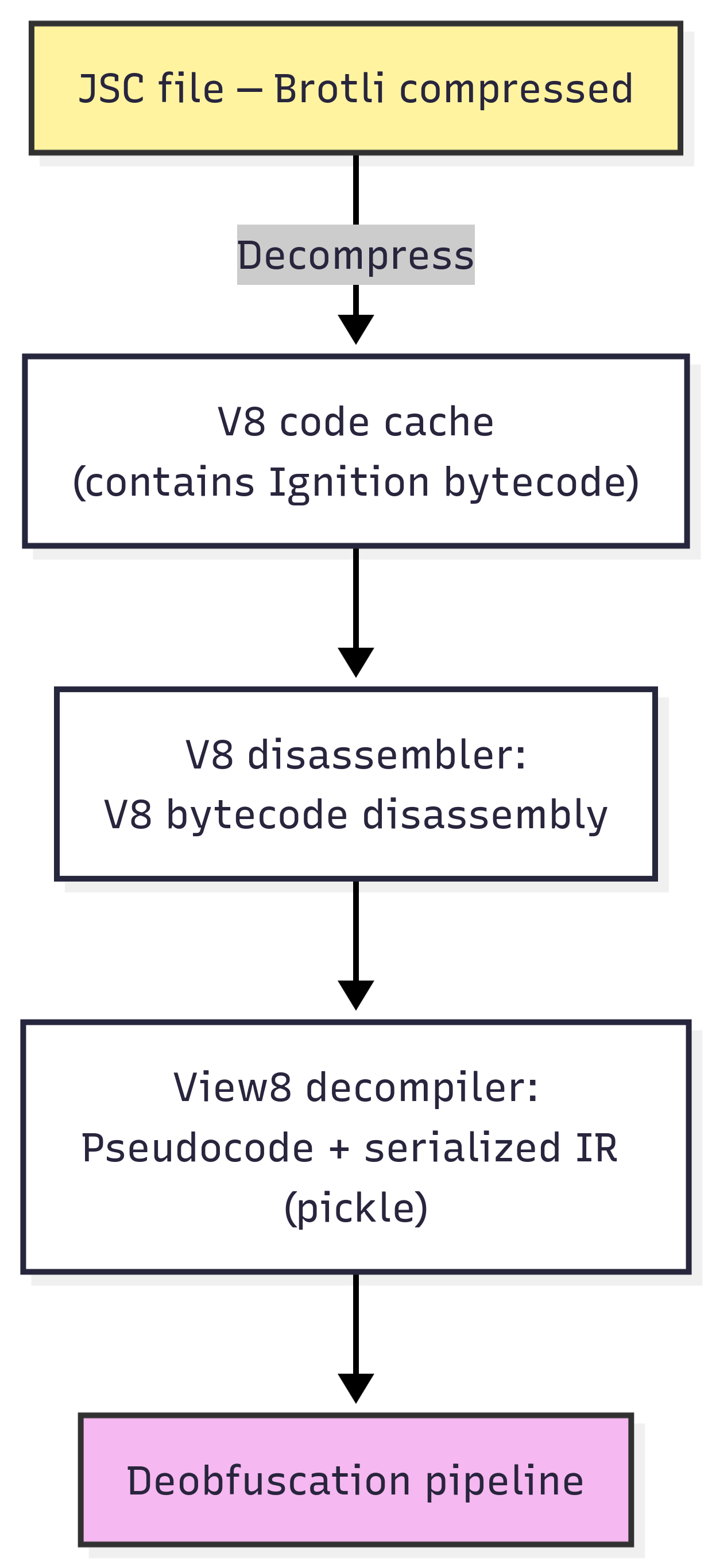
Our toolkit is publicly available at https://github.com/hasherezade/jsc_deobfuscator [7]
The following flowchart describes the major steps of the pipeline; details of each follow in subsequent
Key Takeaways
- Check Point Research details static deobfuscation of JSCeal's compiled V8 bytecode, revealing techniques used by advanced JavaScript malware.
- Understanding V8 bytecode obfuscation enables defenders to detect and analyze sophisticated JavaScript-based threats more effectively.
- Organizations should review the full article for complete details and implement relevant security measures.