Armored Likho expands its cyber-espionage toolkit
August 13, 2026 · Kaspersky (Securelist) · Severity: MEDIUM
Armored Likho, also known as Eagle Werewolf, has expanded its cyber-espionage toolkit with Rust-based implants like Still Sync for Telegram data theft and Still Audio for surveillance. The group targets Russian entities via a malicious donation app dropper, continuing its focus on multi-industry infiltration.

In May 2026, we discovered a new cyber-espionage campaign by the Armored Likho group, also known as Eagle Werewolf, that targets private individuals and organizations across various industries in Russia, including major corporations, the public sector, IT, and education. The attackers used a fake app as bait that mimics a service for donations. However, the most interesting part of this campaign isn’t the initial infection method – it’s the malicious implants the attackers use for cyber-espionage.
We’ve written previously about recent Armored Likho attacks, but our analysis shows that the campaign discussed below has more in common with the group’s activity from February. That said, the attackers have significantly expanded their arsenal.
During our research, we found a new cyber-espionage toolkit written in Rust: the Still Toolkit. One of its components, Still Sync, steals Telegram session data to gain ongoing access to the victim’s account. With this stolen data, attackers can leverage the Telegram API to automatically pull chat logs, media files, and other information from the account.
The second component, Still Audio, is an implant for covert audio surveillance. It analyzes the incoming audio stream, automatically detects speech, records conversations, and sends the recordings to a command-and-control server.
In this article, we’ll look at the initial infection method, how the new Still Toolkit components are built, and the technical details of how they operate.
Kaspersky products detect this threat as Trojan.Win64.Agent.* and HEUR:Backdoor.Win32.Generic.
Background
Armored Likho’s malicious activity has been documented several times before: in November 2024, and in February and July 2026. The current campaign shows significant overlap with the November and February campaigns, which used malicious droppers disguised as documents and applications related to Starlink activation or fundraising efforts as the initial infection vector. This campaign also uses fundraising as its lure. At the same time, our research uncovered a number of new tools that point to the attackers expanding their capabilities.
Initial infection
The infection chain starts with an app that mimics a donation service. As of this writing, the app distribution method remains unknown. During our research, however, we obtained several samples posing as apps from different Russian foundations.
In reality, the app is a dropper. Its developers wrote it in Rust on top of the popular Tauri framework, and it has a graphical interface designed to deceive the user. After launch, it displays a login form that asks for a password, presumably one the attackers supplied.
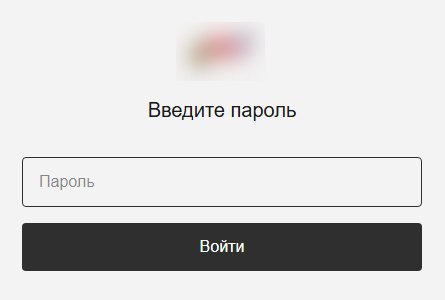
The login form
After the user enters a valid password, they see a catalog of donatable items. The app pulls item and category information from orderapiserver[.]info through the public/categories and public/products endpoints. A clickable catalog makes the app look legitimate. While the user browses the items, the dropper quietly decrypts and launches the payload for the next stage in the background.
Our analysis shows that the mechanism for decrypting the payload and launching subsequent stages hasn’t changed since the February campaign. However, we found a new cyber-espionage toolkit – the Still Toolkit – made up of two components: Still Sync and Still Audio.
Still Sync
Still Sync is a stealer written in Rust that steals Telegram session data. However, its capabilities don’t stop there. With this stolen data, Sync can log in to the victim’s account and pull messages and media files through the Telegram API.
Architecturally, Sync is an asynchronous application based on the Tokio library. It talks to the server over gRPC and serializes messages with FlatBuffers. It supports both HTTP and HTTPS as transport protocols; the URL of the command-and-control server determines which one it uses.
How it works
When Sync launches, the attackers set several environment variables. Before starting any malicious activity, the implant pulls configuration parameters from these:
- STILL_SYNC_ADDR: the address of the command-and-control server. By default, this is
https://tg4service[.]com:443. - STILL_SEND_PATH: the path to the
tdata - STILL_TELEGRAM_PASSCODE: the password for decrypting the
tdatafolder, if Telegram data encryption is enabled on the victim’s device.
Sync also supports several command-line arguments:
--console: runs as a console application. If this parameter is absent, the implant creates a TReload service to keep running in the background.--version: prints version information and exits.--firefly: launches a trace thread that monitors the program’s operation. It writes error messages to a hidden file, bin, located in the same folder as the main executable.--db: turns on debug mode with detailed logging.
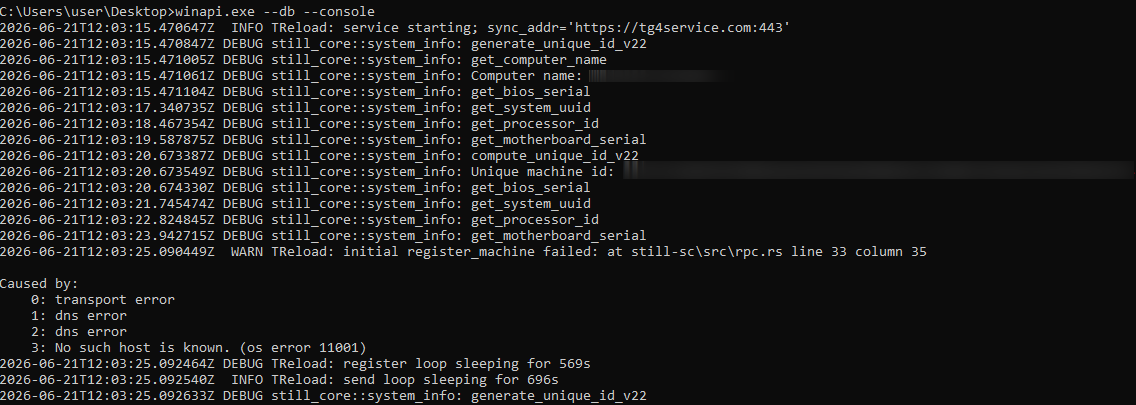
Example Still Sync logs
Once it launches, the malware begins registering the device with the C2 server. To do this, Sync collects the following information about the victim’s system:
- Motherboard serial number
- CPU ID
- System UUID
- BIOS serial number
- Computer domain name
The malware combines the collected data into a single string with a colon as the separator. It then hashes that string with SHA-256 and stores the resulting hash under the key sysmarker. Worth noting: other Armored Likho tools, AquilaRAT included, use this same hashing algorithm.
Sync then serializes a package containi
Key Takeaways
- Armored Likho's new Still Toolkit includes Still Sync for Telegram session theft and Still Audio for covert voice recording.
- The group uses a fake donation app as a dropper, leveraging Rust and Tauri framework for deception.
- Targets include Russian corporations, public sector, IT, and education, showing a broadened cyber-espionage focus.