ACR Stealer: Two observed intrusion chains amid increased threat activity
July 16, 2026 · Microsoft Security · Severity: MEDIUM
Microsoft Defender Experts observed heightened activity involving ACR Stealer malware between late April and mid-June 2026, targeting enterprise environments through two distinct campaigns. Both campaigns begin with a ClickFix social engineering technique, tricking users into executing malicious commands, but diverge in their delivery methods. The first campaign uses WebDAV-delivered payloads, Python-based loaders, and blockchain-backed command-and-control (C2) infrastructure, while the second employs fileless techniques like MSHTA, obfuscated PowerShell, and steganography to execute payloads in memory. Both aim to steal browser credentials, session tokens, and sensitive documents, enabling account takeovers and unauthorized cloud access. ACR Stealer operates under a malware-as-a-service (MaaS) model, linked to the rebranding of Amatera Stealer. The first campaign leverages WebDAV shares and GUID-based paths to blend with legitimate traffic, while the second minimizes detection using headless execution and environment variable obfuscation. Microsoft Defender for Endpoint can detect these campaigns by monitoring for suspicious WebDAV activity, obfuscated PowerShell, and browser credential theft. Organizations should prioritize defenses against these techniques, as ACR Stealer’s evolving tactics pose significant risks to enterprise security.
From late April 2026 to mid-June 2026, Microsoft Defender Experts observed increased ACR Stealer activity across customer environments. These campaigns are successfully using ClickFix lures to steal browser credentials, authentication tokens, and sensitive documents from enterprise environments. Successful compromise can expose browser credentials, session tokens, authentication artifacts, and sensitive enterprise data, potentially enabling account compromise, unauthorized access to cloud resources, and follow-on intrusion activity. Security teams should prioritize monitoring for ClickFix lures, suspicious WebDAV activity, obfuscated PowerShell execution, and attempts to access browser credential stores.
ACR Stealer is an information-stealing malware family reportedly offered through a malware-as-a-service (MaaS) model and associated with the rebranding of Amatera Stealer. During this period, two campaigns stand out, together appearing frequently in reviewed recent intrusions. Both begin the same way, with a ClickFix social engineering technique that tricks targets into running the threat actor’s command, but the intrusion chains that follow diverge in how they deliver payloads, establish execution, and evade detection.
The first campaign relies on WebDAV-delivered payloads, staged PowerShell, Python-based loaders and persistence, and, in some intrusions, blockchain-backed dead-drop command-and-control (C2) resolution. The second campaign takes a more fileless route, using MSHTA, obfuscated PowerShell, and steganography-assisted in-memory execution. Despite these differences, both campaigns ultimately pursue the same goal: stealing browser-stored credentials and other sensitive data for exfiltration.
These two campaigns represent some of the most prevalent ACR Stealer delivery campaigns observed by Defender Experts; however, they do not represent the full range of delivery methods used by this malware family. Attribution to ACR Stealer is based on the observed behavior and post-exploitation tradecraft, corroborated by open-source intelligence on the infrastructure associated with this malware family. Additional campaigns, infrastructure patterns, and execution chains are likely active, and organizations should treat the indicators and techniques described here as representative.
Microsoft Defender for Endpoint can help surface both campaigns through behavioral coverage for living-off-the-land execution, suspicious WebDAV and MSHTA activity, obfuscated PowerShell, scheduled-task persistence, in-memory payload execution, and browser credential theft. In this blog, we analyze both campaigns in detail, including their delivery mechanisms, post-exploitation tradecraft, indicators of compromise, hunting opportunities, and guidance to help defenders detect and disrupt related activity in their environments.
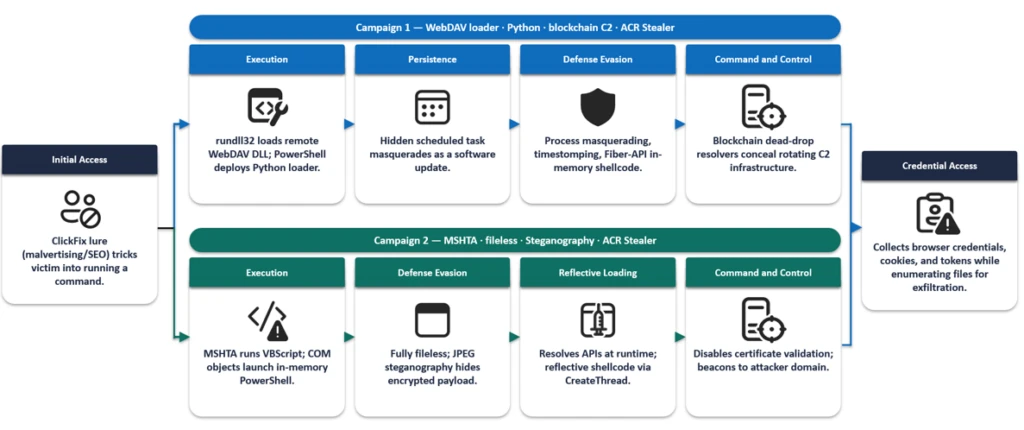
Campaign 1: WebDAV-based ClickFix with Python loaders and blockchain C2
Initial access
In this campaign, a ClickFix prompt, likely delivered through malvertising or SEO-manipulated search results, instructs the target user to run a command that launches cmd.exe. The command subsequently invokes rundll32.exe to load a DLL from a remote WebDAV share accessed over HTTPS. The WebDAV path commonly uses a GUID-based directory structure and filenames designed to resemble legitimate resources (for example, google.ct), enabling the activity to blend with expected network traffic and evade casual inspection.
We observed three variants of the initial execution command:
Variant 1: Direct rundll32 invocation

Variant 2: pushd-Mounted WebDAV Share

Variant 3: Headless and obfuscated pushd execution

Variants 2 and 3 are notable for their use of pushd, which transparently maps the remote WebDAV share to a temporary local drive prior to execution. This technique allows threat actors to execute remotely hosted content through what appears to be a local path, simplifying payload execution while reducing user awareness. In the more advanced variant, threat actors further enhance stealth by launching commands through conhost.exe –headless, suppressing visible console windows, and employing environment variable obfuscation with delayed variable expansion to conceal critical execution components such as pushd, rundll32, and the remote host name. Combined with minimized or headless execution, these techniques reduce user visibility, complicate static analysis and detection, and enable the infection chain to execute with minimal indication to the victim.
Execution, persistence, and evasion through process masquerading
Once rundll32.exe loads the DLL retrieved from the remote server, the malware establishes communication with threat actor-controlled infrastructure and executes a heavily obfuscated PowerShell script. The script employs excessive arithmetic no-ops, dead loops, fake control flow, and randomized variable names to hinder static analysis and evade signature-based detection.
The PowerShell script subsequently deploys another stage that functions as both a malware installer and a persistence mechanism. It:
- Downloads a ZIP-packaged payload fro
Key Takeaways
- This Campaign 1: WebDAV-based ClickFix with Python loaders and blockchain C2 Campaign 2: MSHTA-initiated PowerShell chain with steganograph.
- These campaigns are successfully using ClickFix lures to steal browser credentials, authentication tokens, and sensitive documents from enterprise env.
- Successful compromise can expose browser credentials, session tokens, authentication artifacts, and sensitive enterprise data, potentially enabling ac.